Kenya’s Ownership Society
The community service workers we have met here in Kenya are very, very worried about social programs creating dependency on the government. Thus, whenever they talk about their social programs, they emphasize the importance of the individuals "taking ownership."
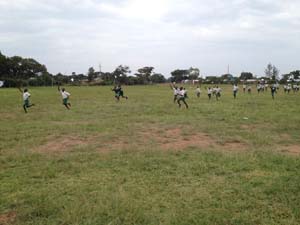
Recess
Photo: Mark Thoma
For example, elementary schools are supposed to be free, but in practice they are not. Parents must buy school uniforms, they must pay teachers extra to get the "full curriculum," there can be development fees for buildings, and so on. In the end, though it's supposed to be free, a substantial number of students are excluded from basic education. The purchase of the school uniform seems to be the biggest barrier.
High school, too, is very expensive for most families; there is tuition to pay in addition to uniforms and other costs, so that most families of limited means cannot afford it.
As another example: Ol Pejeta, the (privately owned) conservancy for endangered animals, helps the communities around it in order to create acceptance for the conservancy (which imposes many costs on the communities). But when they help students, they only pay the fees; they won't pay for uniforms or other costs because, they say, parents must take some degree of ownership--even though this attitude hurts substantial numbers of children who are excluded from the school system. Similar attitudes are applied to maternity care: parents must take some degree of ownership or be excluded, even when it might hurt unborn children.
There are many other examples of this, and there are some examples where "taking ownership" has positive effects. When mosquito nets are given away for free, they end up being used as fishing nets, in chicken coops, for all sorts of things that have nothing to do with their intended use. A token payment -- taking ownership -- helps to solve this problem.
So I can understand the fear of dependency in a society such as this, and there is evidence that "taking ownership" can be helpful. But I cannot understand allowing children to be hurt because of it. Sure, there might be a benefit -- some parents will take more interest/ownership in the process. But there is also a cost. Many children are excluded from school, and the people paying these costs, the children, are not the ones making the choices. To me, the costs of excluding so many children is far greater than whatever benefit might come from "ownership," and if it were up to me far more resources would be directed toward educating children. It's an investment in the future Kenya will not regret.
More from this Reporter
- Sarah Obama: Barack Was Born in America
- Staying Connected on the Road
- Mark Thoma Reports From Kenya
- The Water Project at Ol Pejeta Conservatory
- Kenya’s Mobile Money Transfer System
- Evaluating the Millennium Villages
- Mama Sarah Obama
- The Pumwani Maternity Ward
- Kenya’s Kibera Slum
From Other Reporters in This Country
Also appeared in…
- Economist's View