In Benin, Genetically Modified Cotton Not Option for Now
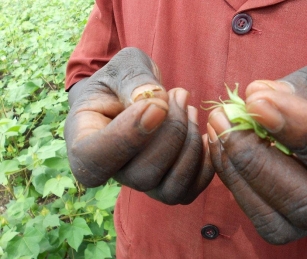
Photo: Alex Daniels
Farmer Sero Modougou inspects a cotton boll that has been ruined by a bollworm. Benin has placed a two year moratorium on using genetically-modified cotton that is resistant to pests.
Dismayed, Sero Modougou walked among his cotton plants, scanning the damage.
The cotton campaign was just two months away and to the untrained eye, Modougou's two- and three-foot high plants, which have stalks as thick as a magic marker and pretty pink and white flowers, look like they're progressing fine.
Modougou reaches down, picks off one of the plants boll's and the reason for his concern becomes clear. Usually the pods open easily, but this one is infected and has become rigid.
Squeezing open the cotton boll in his palm, he forces it open and digs out the culprit: Earias insulana. The little worm with the Latin name, commonly called the bollworm, is ruining his crop, just as it and its cousin, heliothis armigera, have devoured acres of cotton land throughout the globe.
A few hours drive north, over the border in Burkina Faso, farmers are using Bt Cotton, a genetically-engineered strain of the plant that is resistant to the pests.
Over the past five years, Modougou's yields have dwindled from 1.8 tons a hectare to 1.5 tons a hectare. A hectare is equivalent to about 2.471 acres.
To increase his yield and produce a more uniform fiber that can get a better price, Modougou would like Benin's farmers to join their northern neighbors "” and most of the world's cotton farmers "” and begin using the genetically modified plants.
"The price is good," he says. "The farmers are pushing for it."
But Benin is in the middle of a two-year government-imposed moratorium on the use of genetically engineered cotton.
After a study of the pros and cons of biotech cotton, the country's parliament is set to vote on the matter in 2013.
The use of genetically modified crops has been a source of concern for years because, among other things, they can have unintended harmful effects on other plants and animals and that their widespread use can wipe out local plant cultures and reduce the diversity of plant life.
Edwin Wennink, chief of party with the West African Cotton Improvement Program, a U.S. Agency for International Development project that works with Benin's farmers to increase cotton yields and develop markets for cotton, points to another problem "” their use would hit pesticide providers and ginners in the pocket book.
He said that input prices "” the cost of fertilizer and pesticide "” are 25 percent higher in Benin than they are in Europe, and Asia. The reason for the high price, he said, was that one person, Patrick Talon, a businessman who is close to Benin's President Boni Yayi, controls most of the supply. Talon also has a large share in may of the country's cotton gins.
Using normal cotton, a farmer in Benin has to apply five or six pesticide treatments a year. Planting Bt cotton would reduce that to two applications, cutting back on the amount of pesticide a farmer would need. Bt cotton seeds are also smaller than regular seeds. Their use, Wennink said, would mean cotton ginners would see a lower price when they try to sell them on the cottonseed oil market.
Talon, who is based in Cotonou and has a large share of the country's ginning and pesticide market through his Society for the Development of Cotton, did not respond to an interview request.
Coerneille Ahanhanzo and his team of about a dozen students at the University of Abomey-Calivi, which sits on a wooded campus on the outskirts of Cotonou, Benin's main city, are preparing for the possibility that the genetically modified plants will be used in Benin.
Currently his team of about a dozen students is in the process of saving and tracking the genetic codes of plant samples from many varieties of crops native to Benin.
Ahanhanzo said the prospect of using genetically modified cotton could be a positive, because it would lower the use of toxic pesticides. But he warned that farmers would not be eager to have to buy new seeds each year from a supplier.
And a recent trip to Burkina Faso, where farmers are using the plants, convinced him that more research has to be done in how to space the plants, when to apply pesticides, and what crops they can be planted near. "They were making mistakes," he said. "We want to understand what mistakes they are making and minimize our risks."
"After that, we can train literate farmers, and they can be a model to the other farmers.
"Gradually," he said, "gradually."
Alex Daniels reported from Benin with a grant from the International Reporting Project (IRP).
More from this Reporter
- Batesville to Benin: West African Preaching School Helped by Southern Churches
- Cotton Growers in Limbo
- With No Money to Fight U.S., 4 Took Cotton Case to WTO
- In Tiny Benin, Cotton Is King
- Beninese Scrape by on Average of $730 a Year
- From Benin to Arkansas
From Other Reporters in This Country
Also appeared in…
- Arkansas Democrat-Gazette