Beninese Scrape by on Average of $730 a Year
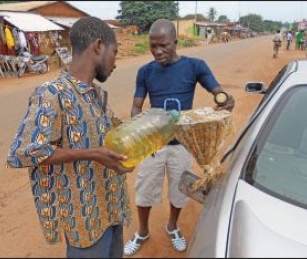
Photo: Alex Daniels
Most motorists in Benin buy their fuel on the black market at roadside stands like this one in Bohicon, in the southern part of the country.
The van, having made pickups at roadside gas stands throughout Cotonou, snaked along pitted, dirt side streets toward the drop-off point.
Empty, plastic gas containers filled the van to capacity. Dozens more, stacked on top of the vehicle, bounced and shimmied as the van pulled up at the lagoon where piles of additional yellow cans waited for the next trip to Nigeria.
Five men in their 20s watched as two elementary school-aged children tossed cans from the van to the ground and loaded them into skiffs waiting at the water's edge.
In Benin, where the official unemployment rate is 22 percent and the average per capita income in 2010 was $730 a year, people hustle for any work they can get.
Truckers break barricades at the country's main port and sleep next to the dock for days under their dilapidated rigs, waiting for a load of goods to haul. Along roadsides, mothers and their children sell peanuts, yams or the occasional fresh-killed bush rat, a specialty in some areas of the country.
For the crew at the lagoon, the payoff comes three times a week, when they ferry oil, illegally tapped from Nigeria's pipelines, through a maze of rivers and lagoons across the border into Benin.
There are few gas stations in Benin. Instead, the black market gas is sold to people at roadside stands whose operators store the fuel in clear-green 10-gallon vases and haggle over prices with motorists.
The government doesn't collect a single franc in taxes from the black-market operations.
The group's leader, who declined to give his name, wore a T-shirt and a ring with a gold nugget the size of an acorn on his left hand. His business partner's hat read: "Super Bitch."
"We fear the police, and we fear the army," the leader said, "but there is a large profit."
Sixty-two miles north, about 40 women workers pounded on a giant granite mound on the outskirts of Parakou, Benin's second largest city.
Using homemade hammers that consist of rings of iron attached to rough wooden handles, the women sat on the rock under corrugated lean-tos that shielded them from the sun and rain, and tapped away at the stone. With each hammer swing a little more rock broke away. Piles of potato-sized stones, pebbles and fine sand "” each marking different stages in the process "” surrounded each woman.
The tapping continued after sunset.
The stone is crushed to make a cement-type powder that will be used in construction projects throughout the country, many of which are run by Chinese engineers and crews of Beninese laborers.
Just north of Parakou, such a crew cleared trees, moved earth and worked on bridges to extend one of the country's few paved highways northward.
Just a week earlier, Benin's President Boni Yayi had completed a 10-day trip to China that bore immediate fruit. The Chinese agreed to give Benin a package of $34 million in aid and interest-free loans.
The women who pound the rock into construction materials earn about $1.30 for every 220 pounds of stone they chip away.
Usually, said Joseph Mikpon, who manages the operation, it takes at least a day to pound that much stone. He said the wage was standard for that type of work.
One of the quarry women, Blanche, has worked on the stone for more than two years. Wearing flip-flops and a yellow T-shirt, her tightly coiled hair bounced with each hammer swing. She giggled shyly when asked a question. "The work is very difficult," she said.
Twenty feet way from Blanche, a woman named Awahou sifted a handful of powdered stone into a pile. Awahou, who also did not want to give her full name, said she does not know how old she is. She has five children, between ages 5 and 22. Her friends told her about working on the rock slab when her home-based business "” selling cooked yams "” failed.
She pointed at a 3-foothigh pile of powder "” her day's work. "I'm a bit happy," Awahou said. "I did something today."
Alex Daniels reported from Benin with a grant from the International Reporting Project (IRP).
More from this Reporter
- Batesville to Benin: West African Preaching School Helped by Southern Churches
- Cotton Growers in Limbo
- With No Money to Fight U.S., 4 Took Cotton Case to WTO
- In Tiny Benin, Cotton Is King
- From Benin to Arkansas
- In Benin, Genetically Modified Cotton Not Option for Now
From Other Reporters in This Country
Also appeared in…
- Arkansas Democrat-Gazette