Religious Extremism, Tolerance Clash in Indonesia
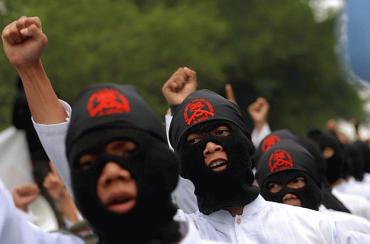
Muslim youths swear to become martyrs in the event of Osama bin Laden's death at a 2010 rally in Central Java, Indonesia.Anwar Mustafa / AFP/Getty Images
On Good Friday, Pepi Fernando and four of his college friends planted several bombs in a sewer near a West Java Protestant church, setting a timer for the hour they expected the building would be filled with as many as 3,000 worshipers.
But the men were being watched by the nation's anti-terror police, who arrested them and defused the explosives.
Fernando, 32, who told police he had also placed bombs in books and sent them to liberal Muslims and counterterrorism officials, represents a new generation of extremists among the world's largest Muslim population - freelance terrorists.
The lone militants, along with members of established militant groups that openly advocate for an Islamic state, have increased their attacks in recent months on "enemies of Islam" and religious minorities, and threaten Indonesia's 13-year-old democracy.
Religious fundamentalism is "now virulent in the country," B. Herry-Priyono, lecturer at Jakarta's Driyarkara School of Philosophy, wrote in a May editorial in the Jakarta Post.
In April, militants planted the first suicide bomb in a mosque, injuring 28 people. Recent raids on police stations have killed several officers. Extremist groups have begun recruiting on high school and college campuses, and Saudi money has established fundamentalist-style madrassas.
This week, police arrested 16 people on suspicion of plotting cyanide attacks against police, including a major suspect in the 2002 bombings on the island of Bali that killed 202 people, mostly foreigners - second in deaths only to the Sept. 11 terrorist attacks on the United States.
The surge in Islamic militancy comes more than a decade after Indonesia returned to democracy following the 31-year authoritarian rule of Gen. Suharto, who had held extremism in check. Many militants returned from exile, including Abu Bakar Bashir, the elder statesmen of the radical movement who was sentenced to 15 years in jail on June 16 for helping to finance a terrorist camp in Aceh province. Bashir, 72, is the spiritual leader of the al Qaeda-affiliated Jemaah Islamiyah (Islamic Congregation), which took credit for the Bali attacks. He served almost 26 months in prison for the bombings before his conviction was overturned for lack of evidence.
Bashir, 72, is the spiritual leader of the al Qaeda-affiliated Jemaah Islamiyah (Islamic Congregation), which took credit for the Bali attacks. He served almost 26 months in prison for the bombings before his conviction was overturned for lack of evidence.
Some observers say Indonesia's democracy will resist Islamic fundamentalism largely because of the nation's moderate brand of Islam, which incorporates earlier Buddhist and Hindu customs. Others point to the nation's affection for a national philosophy known as Pancasila that has long been a nettlesome issue for Muslim extremists.
Sanskrit for "five principles," Pancasila was introduced in 1945 by Indonesia's first president - Sukarno - as a bulwark against radical Islam. It encompasses the secular tenets of humanitarianism, national unity, consultative democracy, social justice and belief in an unspecified supreme being. Pancasila is the Indonesian version of E pluribus unum, the U.S. dictum that means "Out of many, one."
"It's how we define ourselves," said Muhammad Fadel, an 18-year-old economics student at Jakarta's University of Indonesia.
While democracy waxed and waned for the next 53 years under the regimes of two strongmen, Pancasila continued to promote pluralism and diversity for the nation's six state-sanctioned religions - Islam, Protestantism, Catholicism, Buddhism, Hinduism and Confucianism - and numerous ethnic groups, which speak 700 languages.
Not surprisingly, politicians, journalists and artists are touting Pancasila ideals in speeches, columns, rap songs and YouTube videos as a counterweight to extremism. To commemorate the 66th anniversary of Pancasila on June 1, President Susilo Bambang Yudhoyono vowed never to allow Indonesia to become a religious state.
"There is no place for such intentions in our country," he said.
Some radical groups, including the Islamic Defenders Front, say they support Pancasila ideals, but are fighting for a more Islamic society. In recent years, its members have patrolled bars, night clubs, gambling dens and rock concerts, attacking couples kissing in public, erotic Javanese and Balinese dances and swimsuited sunbathers.
"We are not against pluralism and diversity," said Habib Rizieq, the group's Saudi-educated leader. "What we are against is blasphemy."
While the government has cracked down on Jemaah Islamiyah and other terror organizations, it has been less successful stopping physical attacks on religious minorities, especially Christian churches and the Ahmadiyah Muslim sect. The Ahmadiyah are considered apostates for believing their founder - Mirza Ghulam Ahmad, who died in 1908 - was the last great prophet, instead of Muhammad.
Since 2004, there have been 430 attacks against Christian churches and 183 attacks against Ahmadiyah followers, according to Human Rights Watch in New York.
Some critics blame Yudhoyono for not taking a stronger stance against such violence for fear of appearing to be anti-Islam and angering wealthy and military backers of extremist groups and Islamic parties in parliament.
"They are giving the radicals too much room," said Yenni Wahid, a liberal Islamic activist and daughter of the late President Abdurrahman Wahid (1999-2001).
Wahid and other critics point to several government decisions to placate rising conservatism.
A 2008 decree threatened Ahmadiyah worshipers with jail if they spread their beliefs. Also that year, parliament passed an antipornography law, calling for sentences of up to 12 years for producing or distributing pornography, and four years for mere possession. In 2006, the Islamic Defenders Front forced editors of Playboy Indonesia magazine to flee to Hindu-majority Bali after attacking its Jakarta office.
"Pornography is a favorite wedge issue for extremists," said Wahid. "They use it just like the Republicans use abortion in the U.S."
But Yudhoyono contends that democracy and the nation's moderate form of Islam remain strong.
"If you look at the big picture," he told a group of visiting U.S. journalists last month, "you will see that harmony, tolerance and unity are still here."
Jack Epstein, Foreign Editor at the San Francisco Chronicle, visited Indonesia in May on a fellowship sponsored by the International Reporting Project. E-mail him at .(JavaScript must be enabled to view this email address).

More from this Reporter
- Indonesia Is a Nation of Contrasts
- Indonesian Government Battles Corruption
- Fight to Save Rainforest in Indonesia
- In Indonesia, Rampant Smoking Begins at Early Age
- In Egypt, the Pharaohs’ Outspoken Defender Kicks Up a Dust Storm
- From Cairo’s trash, a model of recycling
- Fundamentalism fears