Fight to Save Rainforest in Indonesia
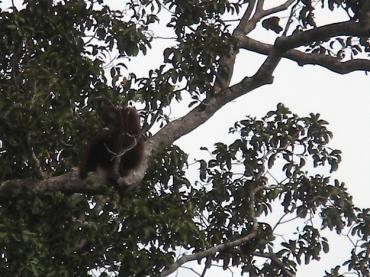
A rare sighting of an orangutan in the wild in Kalimantan. Their population is shrinking due to habitat loss.Jack Epstein / San Francisco Chronicle
After several years of clear-cutting Borneo rain forests for timber firms, Iskandar had an epiphany. "I was making a lot of money, but I suddenly thought, once the forest is gone, we won't have anything to live on."
Iskandar, who like many Indonesians is known by just one name, had previously cut trees to feed his family. But now the indigenous leader of former headhunters is fighting to keep a palm oil company from clear-cutting his village's forests in Borneo, the world's third-largest island after Greenland and New Guinea.
Iskandar's struggle has global implications.
At least 2 million acres of Borneo's lush rain forests have been logged annually over the past two decades, and about half of those forests are now gone. At the current rate, less than 30 percent will remain by 2020, according to the World Wildlife Fund. Such devastation has earned Indonesia a place in the Guinness Book of World Records as the country with the highest rate of deforestation.
Moreover, the rapid destruction of the island's carbon-rich forests and peatland - partially carbonized vegetable matter found in moss and bogs - has helped turn Indonesia into the third-leading emitter of greenhouse gases after China and the United States. For National Geographic Magazine, "Borneo's future may well be the most critical conservation issue on our planet."
Two other nations - Malaysia and Brunei - share ownership of Borneo, which is about the size of Texas and Oklahoma combined and sits between the South China and Java seas. Indonesia owns the largest section, which is known as Kalimantan. To date, Iskandar's village of 1,610 Dayak tribal members in West Kalimantan has defied political pressure from local officials who back the Indonesian-Australian firm - PT Kayung Agro Lestari - and its efforts to establish an oil palm plantation on their lands. In contrast, the nearby 30-family Dayak community of Manjau allowed the same company to cut its trees after it was promised new roads, schools and health clinics.
"We hope they are not lying to us," Manjau village leader Victor Sirianto said.
These two scenarios are being played out across Borneo, some communities saying yes and others saying no to the latest Indonesian gold rush - palm oil. Indonesia is the world's largest producer of the popular oil, claiming 47 percent of the global market.
For decades, Borneo has attracted Indonesians and foreigners of every ilk seeking diamonds, gold, uranium, coal, timber, oil, natural gas and even swiftlet nests, the key ingredient of bird's-nest soup, a Chinese delicacy.
The assault on the island's natural resources has taken a heavy toll on the area's exotic wildlife, which includes proboscis monkeys, king cobras, flying snakes, pygmy elephants, rhinoceroses and bearded pigs. Borneo is also home to 600 species of birds, 2,500 species of orchids and the largest flower in the world - the Rafflesia arnoldii, which can weigh up to 18 pounds.
The iconic symbol of Borneo deforestation, however, is the orangutan, the only great ape found outside Africa. At the turn of the last century, about 315,000 lived in the wild. Today, an estimated 60,000 remain, an estimated 50,000 in Borneo and the rest in Sumatra.
David McLaughlin, the World Wildlife Fund's managing director of agriculture, says the key to stopping the accelerated deforestation is ending corruption. Police have long accepted bribes from timber companies to cut trees in protected forests - an estimated 35 of Borneo's 41 nature reserves have been logged - and from oil palm plantations to burn forests. "Legal enforcement is the root cause of the problem," said McLaughlin, whose recent survey of 967 Kalimantan operations showed that 92 percent did not have legal permits to convert forests into plantations or mines.
With much of the timber gone, the driving force of rain forest destruction is now the soaring demand for palm oil. The oil from the tree's fruit is used in countless products, including cooking oil, soaps, cosmetics, margarine, cakes, ice cream, cookies, detergents, chocolate and even biofuel. According to Forbes Indonesia, 16 of Indonesia's 21 billionaires made their fortunes in palm oil or coal mining or both. Eka Tjipta Widjaja, the patriarch of the nation's largest palm oil company, Sinar Mas Group, recently replaced tobacco baron Budi Hartono as the nation's richest man, according to Globe Asia's 150 Richest Indonesians list for 2011. In just one year, the 88-year-old magnate tripled his fortune from $4 billion in 2010 to $12 billion because of palm oil expansion.
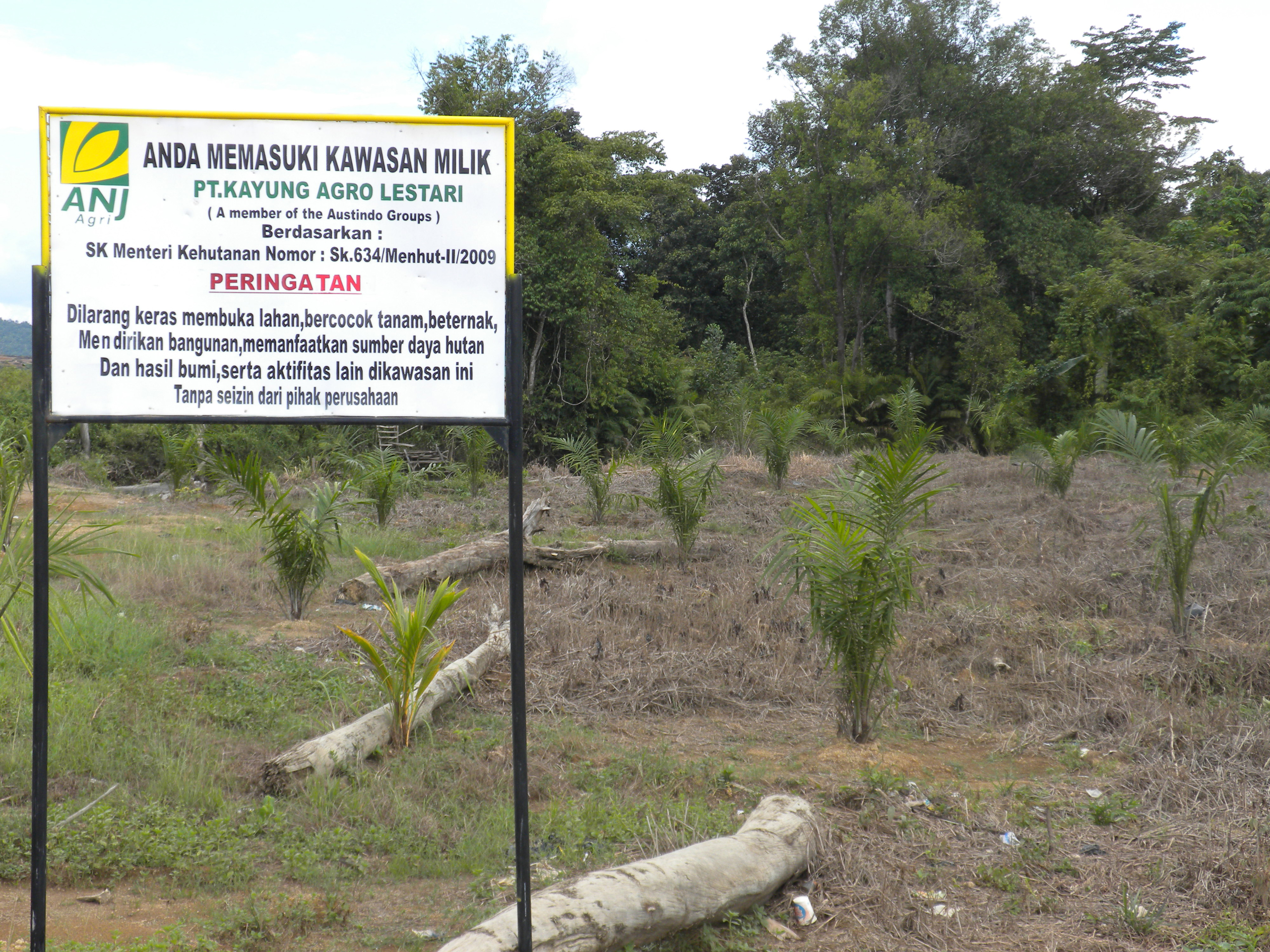
On a PT Kayung Agro Lestari palm oil plantation, a no-trespassing sign stands near newly planted trees.Jack Epstein / San Francisco Chronicle
In the meantime, there are signs of change.
PT Kayung Agro Lestari, the company that Iskandar's village has kept at bay, could be a model for other palm oil firms. Philip Liu, a company vice president, says 19,000 acres of the firm's 44,000-acre Borneo plantation have been set aside as a jungle corridor for the orangutan and other wildlife to migrate between forests.
"If more companies do this, the orangutan might survive," said Suci Utami Atmoko, a biology professor at the University of Indonesia in Jakarta.
Most important, Indonesian President Susilo Bambang Yudhoyono signed a two-year moratorium last month on new plantation concessions that would have cleared 158 million acres of virgin forests and peatland in exchange for $1 billion from Norway to reduce deforestation and cut greenhouse gas emissions by at least 26 percent by 2020. It is part of a U.N. program known as Reduced Emissions From Deforestation and Forest Degradation.
Some experts believe rich countries paying to stop global warming by preserving rain forests could be the last hope for Borneo.
San Francisco Chronicle Foreign Editor Jack Epstein visited Indonesia in May on a fellowship sponsored by the International Reporting Project (IRP). E-mail him at .(JavaScript must be enabled to view this email address).

More from this Reporter
- Religious Extremism, Tolerance Clash in Indonesia
- Indonesia Is a Nation of Contrasts
- Indonesian Government Battles Corruption
- In Indonesia, Rampant Smoking Begins at Early Age
- In Egypt, the Pharaohs’ Outspoken Defender Kicks Up a Dust Storm
- From Cairo’s trash, a model of recycling
- Fundamentalism fears