Indonesian Government Battles Corruption
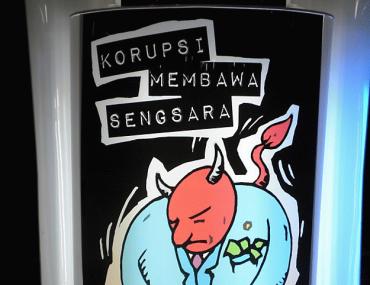
The government campaign to curtail corruption includes this poster hanging at Jakarta's airport that says "Corruption brings misery."Jack Epstein / San Francisco Chronicle
Former finance ministry official Gayus Tambunan was jailed late last year on suspicion of taking bribes from companies seeking to evade taxes. But the prison bars proved surprisingly flexible. Tambunan, who had accumulated a $12 million personal bank account, reportedly bribed his way out of jail nearly 70 times. He even paid immigration officials to supply him with false papers, allowing him to travel to Singapore, Kuala Lumpur and Macao.
Many Indonesians will tell you that bribery is a way of life in this country, a key to the everyday conduct of police, lawyers, judges and business officials. And the experts agree. A poll last year by the Political and Economic Risk Consultancy of Hong Kong said Indonesia is the most corrupt country in Southeast Asia. Transparency International's latest Corruption Perception Index gave Indonesia a score of 2.8 out of 10.
"Corruption is like Coca-Cola. It's everywhere," said Danang Widoyoko, coordinator of Indonesia Corruption Watch, a nongovernmental watchdog group in Jakarta.
President Susilo Bambang Yudhoyono has made ending "Korupsi, Kolusi and Nepotisme" - Indonesian for corruption, collusion and nepotism - the signature issue of his government. His administration has asked universities to offer anti-corruption classes, placed ads in magazines and newspapers that say "Stop Bribery For A Better Indonesia" and put up posters at transportation hubs with cartoons of the devil in chains and the caption: "Corruption brings misery."
The government has backed up the slogans by giving an anti-corruption commission a mandate to use wiretapping to prove cases in special courts. The result is a 100 percent conviction rate, according to Haryono Umar, the commission's deputy chairman.
In recent years, the commission has made powerful enemies by investigating 42 members of parliament, 10 government ministers, 10 provincial governors and four ambassadors. In one high-profile case, the father-in-law of Yudhoyono's son was sentenced to 4 1/2 years in prison on graft charges.
The commission is seeking authority to investigate foreigners who bribe officials in business transactions since only government officials can be charged with crimes of corruption. In 2010, the U.S. Securities and Exchange Commission charged a former executive of Colorado chemical company Innosepc Ltd. with approving bribes to Indonesian government officials to win contracts. And Missouri's Monsanto Co. paid $1.5 million to the SEC and the U.S. Department of Justice for bribing officials to introduce genetically modified cotton into Sulawesi.
"We have brought more than 150 government officials to justice," Yudhoyono said in a meeting with American journalists last month. "But corruption remains a curse. ... I believe Indonesia will have a clean system in 15 to 20 years."
Meanwhile, Tambunan's luck ran out late last year while he watched a tennis tournament on the resort isle of Bali. Even though he wore a wig to conceal his identity, an old school chum on assignment for the daily Jakarta Globe recognized him and snapped his photo. When it appeared in the paper the next day, it set off a major scandal that gripped the nation for months.
Tambunan was eventually found guilty on four counts of corruption, including attempting to bribe his way out of bribery charges.
San Francisco Chronicle Foreign Editor Jack Epstein visited Indonesia in May on a fellowship sponsored by the International Reporting Project (IRP). E-mail him at .(JavaScript must be enabled to view this email address).

More from this Reporter
- Religious Extremism, Tolerance Clash in Indonesia
- Indonesia Is a Nation of Contrasts
- Fight to Save Rainforest in Indonesia
- In Indonesia, Rampant Smoking Begins at Early Age
- In Egypt, the Pharaohs’ Outspoken Defender Kicks Up a Dust Storm
- From Cairo’s trash, a model of recycling
- Fundamentalism fears