Trying to change minds in the Congo
Katie Thomas
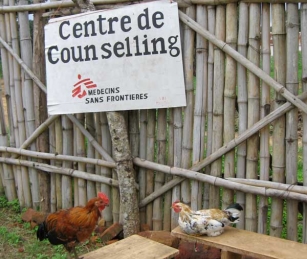
A sign in the waiting area at the Counseling Center at the hospital in Mindouli, one of the largest towns in the Pool Region of the Republic of the Congo.
March 31, 2007
BRAZZAVILLE, Republic of the Congo -- One of the most important tools of Dr. Alain Mouanga's trade is a rubber hammer.
It's not the most predictable tool for a psychiatrist. But it comes in handy in this capital city, where Mouanga -- the country's only working psychiatrist -- must convince his patients he has the power to heal.
At some point during nearly every visit, Mouanga asks his patients to lie on the examining table.
"Don't be afraid," he says as he taps the reflex hammer up and down their bodies, gently lifting and extending limbs.
"It's to reassure them," he admits.
Mouanga knows that if patients don't believe in him, they will leave, instead seeking help from the hundreds of spiritual leaders, herbalists and other traditional healers who claim to cure the mentally ill in this poor country.
Less than a mile from Mouanga's hospital clinic is his chief local competitor -- a Pentecostal church that claims to heal the mentally ill through faith in God.
There, patients can be seen chained to their beds nearly 24 hours a day. The men sleep under ratty plastic tarps, which offer little protection from Congo's tropical rain and sun.
If patients complain or try to leave, they are beaten. "We hit them to discipline them," said Pastor Pierre-Clotaire Galouo, head of the church's mental-illness program. "Those who menace us have lost all reason. They no longer understand anything."
These practices offend Mouanga, who advocates for dignity and professionalism in the medical treatment of Congo's mentally ill.
But he won't openly criticize the church's practices. Mouanga knows that preachers, like doctors, are viewed as healers, a powerful position in African society. "When you disqualify it, then the act of doing so disqualifies you," he said.
Such is the complicated and lonely life of Mouanga, the only working psychiatrist in a nation of 3.7 million. The 44-year-old doctor, a native of the Republic of the Congo who grew up in France, spends much of his time advocating for psychiatry in a country where belief in "la sorcellerie" -- the French word for sorcery -- is widespread and funds for the mentally ill are practically non-existent. His efforts are made more challenging by the reality that mental illness is hard to treat and nearly impossible to cure.
Other health priorities
Mouanga's situation is far from unique across Africa. At least three other countries -- Lesotho, Liberia and Sierra Leone -- also are home to just one psychiatrist, according to the World Health Organization. In Angola, Djibouti, Equatorial Guinea and Malawi -- whose populations total more than 26 million people -- there are no psychiatrists at all.
On a continent wracked by famine, AIDS, malaria and other deadly diseases, mental health care is often severely overlooked, advocates say, knocked under by the double blow of poverty and ignorance.
Across Africa, 70 percent of countries spend less than 1 percent of their health care budgets on mental illness, according to a 2005 survey by the World Health Organization. In the Republic of the Congo the government spends only $25 a year per citizen in health care and there is no separate budget for mental illness. By contrast, the United States spends 6 percent of its health budget on mental health, according to the survey.
"Mental health is not a very sexy subject," said Mark van Ommeren, a scientist who works in the World Health Organization's Department of Mental Health and Substance Abuse. With few resources, psychiatrists such as Mouanga "are left with an enormous amount of responsibility."
More than half of Congo's population is Christian, but it is a Christianity seasoned with African beliefs about evil spirits and demonic possession.
Very few patients walk through Mouanga's gate without having visited a traditional healer first. Their treatments range from fasting to more extreme methods such as scarring and burning of the flesh.
Mouanga sees the fear in their eyes as the patients -- many of whom have been tied up by their families -- enter the grounds of the psychiatric ward. "They are distrustful," he says. "They have a really dramatic image of craziness."
Mouanga and his staff of two Congolese psychologists try to offer the most up-to-date care, using a combination of prescription drugs and talk therapy to treat patients, most of whom suffer from serious illnesses such as schizophrenia, bipolar disorder and severe depression.
Since taking over as head of psychiatry in Brazzaville's main hospital in 2001, Mouanga has worked hard to improve conditions at the ward, installing a water faucet and an electric generator, for example, using funds from individuals and international aid groups.
But a glance around the collection of run-down buildings shows just how much work the doctor has ahead of him. Inside the ward's residential building, the smell of urine and dirty feet stings the nose, and the beds of his 20 patients bear ripped, sagging mattresses. Sunlight pours in through a gaping hole in one room -- a remnant from the country's 1997 civil war.
Government funding limited
The Congolese government provides the buildings and pays the salaries of his staff, which in addition to the psychologists includes a medical doctor and a few nurses, but everything else -- such as sheets, meals and medicine -- must be paid for by families, or provided through funds that Mouanga raises himself.
Despite the obstacles, Mouanga speaks with pride as he gives a visitor a tour. In the courtyard, clusters of men lounge under a mango tree. A relative of a patient cooks lunch nearby over a fire. Since family members live alongside the patients, Mouanga notes with a smile that it's nearly impossible to distinguish the sick from the well.
Less than a mile from Mouanga's psychiatric ward, patients are limited by the length of their chains at the Assemblées de Dieu de Pentecôte. Men and women are tethered to their beds like bicycles to a lamppost.
Some of the patients clearly chafe at the chains. One young man bore a large gauze bandage around his ankle during a visit in November. Others make them into a joke. A woman coquettishly dangled her ankle for a reporter, showing off her shackles as if they were jewelry.
The church's treatment program is founded in the belief that mental illness is caused by evil spirits and sorcery.
"Evil spirits and demons can't be seen or interpreted by a microscope," said Galouo, head of the church's mental-illness program.
The patients stay for as little as a few weeks and as long as several years, waiting for church leaders to announce that God has healed them.
They are unlocked only to wash and to relieve themselves. They are not unlocked to pray.
"The pastors do the praying for them," Galouo said.
With an ever-changing clientele of about 20 patients, the church's program is roughly the same size as Mouanga's psychiatric ward and nearly as respected by the general public.
One mother, Rose-Monique Dzielo-Dzina, brought her son to the church on the advice of a police officer. Dzielo-Dzina, a midwife at Brazzaville's main hospital, said she believes in Western medicine, but not when it comes to the problems of the mind. "What was needed was prayer," she said.
Dr. Mathurin Domingui, who oversees mental health for the Republic of the Congo's Ministry of Health, has visited the church several times and said he witnessed leaders beating patients.
But Domingui said he was hesitant to criticize their methods. After all, he said, "It seems that after this, they are healed. They are able to return to their home."
Promoting psychiatry
Appearances are important to Mouanga. He shuns white coats, for example, instead donning expertly coordinated suits, ties and shirts. As a doctor of the mentally ill, he says, he must look clean and professional.
"I am a politician for the sick," Mouanga said. His goal is clear: to spread the word that mental illness is a treatable disease and deserves as much attention as other illnesses.
"It's very important that I can convince people," he said.
This fall, Mouanga appeared on a Congolese talk show to speak about increasing funding to mental health care. He also organized an open house at the psychiatric ward, inviting high-level officials at the World Health Organization and the Ministry of Health to mingle with patients and relatives.
Slowly, he is seeing progress. Once, Mouanga said, choosing to be a psychiatrist was a job "one was obligated to explain." Why be a psychiatrist, people would ask, when other ailments are more immediately life-threatening? "But lately it's starting to be asked less and less," he said.
Still, not a single student has gone on to practice psychiatry since Mouanga took over the ward. One of his brightest hopes is a 28-year-old student named Géril Sékangué, who in October completed a dissertation on suicide in Brazzaville.
Psychiatry is not taught in the Congo, so after finishing preliminary medical studies in Brazzaville, students must travel to France or elsewhere if they choose to pursue it. Of his own graduating class in 1991, Mouanga said, four of his classmates also went on to study psychiatry, most of them in France. Only Mouanga, who earned his degree in the Ivory Coast, returned to Congo.
If the exodus is to stop, he said, "we must improve the situation in Africa."
The starting salary for a doctor straight out of medical school is about $2,000 per year. While a doctor's salary seems princely in Congo, where half of the population earns less than a dollar a day, it is paltry compared with the sums doctors can earn in the West.
Perhaps Sékangué will be different. He is researching psychiatry programs in France, Canada, England and elsewhere. For now, Sékangué is working as an obstetrician in Brazzaville. "But it's really without passion," he said.
Meanwhile, Mouanga continues to search for new prodigies and tries to accept the fact that he will be Congo's lone psychiatrist a while longer.