Sudan’s Cycle of War
In a far-off corner of the world, seemingly endless years of violence and the famine it engenders threaten to drive the Nuba people to extinction
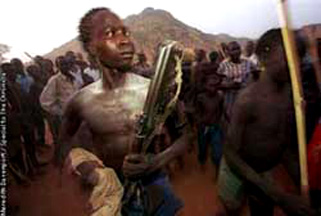
A wrestling match.
NUBA MOUNTAINS, Sudan -- "This is a no-man's-land," whispered Jacob Yusef, a Nuba relief worker, as he walked through the charred plains of the Nuba Mountains in central Sudan.
This is the most fertile land in these mountains, yet it lies uncultivated after 15 years of war. Pathways created by burning routes across the lush plains connect one isolated peak to the next. Under a beating sun, more than 100 women and soldiers carrying supplies and ammunition march silently for 10 hours to reach the regional headquarters of Sudan's rebel movement, the Sudanese People's Liberation Army, or SPLA.
The SPLA has been waging a battle for self-determination with the Islamic fundamentalist government based in the capital city of Khartoum. The 17-year war has cost more lives than those in Kosovo, Bosnia, Rwanda and Somalia combined, with an estimated 2 million deaths in conflict and related famine.
The people of the Nuba Mountains account for a large portion of the losses, and many human rights groups assert that they are facing genocide. In 1985 about 1.3 million Nuba lived here, while now there are roughly 250,000.
The conflict has both religious and racial components. The largely Christian and traditional African societies of southern Sudan have engaged in several separate rebellions against the Arab-dominated Muslim central government in the northern part of the country.
After a decade of relative peace, civil war re-ignited in 1983 when the Khartoum government reneged on a peace agreement that granted autonomy to the south.
The Nuba allied themselves with the SPLA in 1985, after government-backed Arab militias attacked their villages. The militias burned crops and homes, rounding up and killing local leaders.
Those not strong enough to flee into the hills were killed or taken into camps the government insists on calling "peace camps," where they were put to work and forced to undergo radical "re-education." Anyone who escaped into the SPLA areas got pushed into the rocky hillsides where farming is difficult. Walking down into the plains is risky -- five Nuba girls were raped on this path in September, according to a local human rights monitor. Government troops tried to stage an ambush just days before this crossing took place.
War has become a way of life for many Sudanese. Military offensives fade away during the rainy season, when it is difficult to transport troops. But after the rains pass and the crops are harvested, the cycle of destruction begins anew.
In December, the World Food Program issued a warning that Sudan might be facing another food crisis in 2001. The Nuba Mountains, which stretch across the central plains of Sudan in South Kordofan state, were cited as an at-risk region.
"Hunger is also one of the enemies of the people in the Nuba Mountains. That is, in fact, one of the objectives of the government -- that people get hungry and be forced to join them in the (government-) held areas," Yusef explained.
The staple crop of the Nuba is sorghum, rich in protein but slow to mature. One yearly harvest must be carefully rationed to last until the following rainy season. This year's rains were unusually short, leaving behind failed crops and the threat of famine.
Yusef and a group of leaders from the Nuba Relief, Rehabilitation and Development Society, a nongovernment organization that gets aid from international charities, recently made a dangerous journey from Kenya to bring in much-needed supplies and assess the food situation. All roads and flights into the SPLA side of the mountains have been blocked by the government for more than 10 years, cutting the Nuba off from the outside world and exacerbating their plight. Their plane was loaded with basic commodities -- salt and clothing, among other things -- flown in by an adventurous pilot willing to land illegally at the region's only accessible airstrip.
Even the United Nations, which has provided relief for war-torn southern Sudan for more than a decade, has been denied access to the SPLA areas of the Nuba Mountains by the Khartoum government. In mid-1999, for the first time, the government allowed an assessment mission to enter the area. Last year, the United Nations carefully brokered an agreement between the SPLA and the government allowing a UNICEF polio vaccination campaign to take place.
U.N. officials are hoping the polio agreement will lead to future access to the mountains, but Nuba leaders are skeptical. The agreement requires that all aid be sent from the northern garrison town of El Obied, where it is checked by government soldiers who decide whether the relief items are appropriate.
SPLA leaders claimed the government blocked essential items such as clothing and bicycles from being sent along with the U.N. workers conducting the vaccine campaign. "The same day that the U.N. took off from here, the government bombed the area -- a civilian area," said Commander Ismael Khamese, the military head of the SPLA in the mountains.
Nowhere is Nuba's isolation more evident than a dirty mud hut near the village of Kauda, which serves as the operating room of the hospital maintained by German Emergency Doctors, the sole foreign nongovernment organization now maintaining a presence in the Nuba Mountains. Patients walk hours and sometimes days to reach the area's single health facility, which can provide only the most basic care.
The modest adobe wards are crowded with people suffering from malaria or gunshot wounds. Children are weighed for signs of malnutrition and put on a high-calorie feeding program. Many of the patients are civilians caught in the cross-fire. Father Francis Yusef, for example, was walking to the town of Jilbou when the government troops ambushed him and left him to die. "I remained in the forest for two days because no one knew about me."
The Catholic priest was fortunate to keep his leg, which was broken by the impact of the bullet. Even small wounds turn gangrenous quickly in the intense heat, and the long walk to the hospital has cost many people their limbs.
Military activity in the mountains has increased in the past year, as the central government tries to gain access to the oil-rich areas that lie directly south of the SPLA area. A pipeline carrying crude oil runs north from Upper Nile state through the Nuba Mountains to the Port of Sudan on the Red Sea, where it is exported.
"For them to secure the running of the oil to the Port of Sudan, they need to clear us," explained Khamese, the SPLA commander.
The oil is generating $1 million a day for the government's war effort, and the consequences have been disastrous. Human rights groups accuse the Sudanese government of using the oil wealth to finance indiscriminate bombing campaigns on civilian targets and of displacing thousands of Sudanese in their effort to extract oil.
The United States applied economic sanctions to Sudan in 1997, prohibiting U.S. investment in the Sudanese oil concessions, but the Canadian company Talisman Energy continues to operate in Sudan, turning a blind eye to the allegations.
Dave Mann, Talisman's manager of investor relations, said the company is operating under the Canadian government's "constructive engagement" policy, and that the company's "oil field development will help the peace process." Talisman has "tried to encourage human rights groups to develop a dialogue" in Sudan, he said.
In a war that is as much about ethnic identity as it is about religion, the Nuba are unique. Their population is a peaceful mix of Christians and Muslims -- often with both faiths being represented in the same family. But their moderation and African identity conflict with Arab influences in the north. If they lose their fight for existence, they will take with them an ancient culture that some claim dates back to the Egyptian pharaohs.
The Nuba see their struggle as the only way to survive. "The problem is to be or not. To change us from being a Nuba, that is what we are fighting against," Khamese said.