Students bring visibility to plight of Ugandan kids
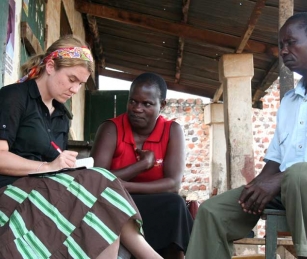
Spring 2006 IRP Fellows Elizabeth Shelburne reporting from Uganda.
Earlier in the school year, Pat Clare, a senior at Mansfield High, attended a concert by the metal band Thrice. The band performed its song ''Image of the Invisible" and urged the audience to check out a website -- http://www.invisiblechildren.com. As soon as he got home, Clare did.
What he found there astounded him.
''Invisible Children" is a documentary about thousands of Ugandan children who must commute to safety in towns miles from their homes each night to avoid being kidnapped by the Lord's Resistance Army, the rebel group fighting in Uganda's civil war, which began in 1986. The 20-year war has led to the abduction of 25,000 children and, according to one recent estimate, kills three times more people each day than die in Iraq.
''It just kind of opened my eyes up the first time I watched it," Clare said.
He's in good company. More MTV than National Geographic, the fast-paced, music-driven documentary has resonated with students across the country. DVDs of the documentary -- it has yet to be released ''on screen" -- are passed around like baseball cards once were, igniting a new strain of student activism.
That has been especially true at Mansfield High.
Clare gave the documentary DVD to two friends, Deanne Jordan and Brandon Stinchfield, also seniors who run the Student Outreach Society. The three arranged to show it to a few classes, and broadcast it over the closed-circuit television system. By day's end, it was all students were talking about.
''I went back to my classroom, and just walking through the hallway, I didn't hear one other conversation," said Alyssa Edwards, 18, a Mansfield student and outreach group member.
With a bake sale, raffle, and the sale of ''End Apathy" T-shirts, the group raised nearly $5,000 to fund education efforts in northern Uganda. The students also, at Jordan's initiative, became part of the Boston-area organizing team for the nationwide Global Night Commute event.
On April 29, in cities across the United States and in several other countries, supporters of Uganda's children joined Global Night Commute rallies, walking and sleeping outside in solidarity with the children of northern Uganda. In Boston, an estimated 500 gathered on the Common followed by a walk to St. Monica's Catholic Church in South Boston, where hundreds of youths piled together in sleeping bags in the churchyard, singing, talking and sleeping, even as the temperature dropped into the 30s.
''Mansfield High, you guys are famous!" shouted Genevieve Luippold, a California-based organizer for the Invisible Children organization, through the bullhorn to the gathered students.
Megan Battle, a Boston College freshman who served as the point person in Boston for the Invisible Children organization, praised their efforts. ''This night would not be going down without the Mansfield kids."
Jordan, Clare, and Stinchfield all buzzed with energy at the event, thrilled to see so many people come out. After the walk to the church, they flitted from person to person, unable to sleep and consumed with excitement, conversation and idealism.
Ruth Bahika, 30, who moved from Uganda to the United States in 1994, was one of the few Ugandans who attended the event. When she arrived at the church, she said, she was amazed by what she saw and heard. ''They were even more informed than we were," she said. ''They weren't just there to make noise. They knew what they were there for."
''Even I learned from talking to them."
The ''Invisible Children" documentary was filmed in 2003 by Bobby Bailey, 24, Jason Russell, 27, and Laren Poole, 22, friends from Southern California who set off to make a film in Sudan. Instead, they found the night commuters in northern Uganda, and documented what they saw. The documentary was released on DVD in 2004, and the filmmakers have encouraged students to share copies with one another.
For most of the students, the documentary opened the door to a world they never imagined existed.
''Now, I don't take going to school for granted or the shoes on my feet," says Edwards, one of the Mansfield students. ''Every time you go to bed and crawl underneath those blankets. It changes everything."
She's not alone. Clare insists that watching television makes him sick now. ''It's not something that's important but it's what we seem to care about."
In fact, the film moved Clare so much that he is hoping to spend part of the summer in northern Uganda volunteering with Invisible Children. He plans to work 40-plus-hour weeks at the CVS in Mansfield to try to raise enough money for his plane ticket and other expenses.
''I feel I should be helping these children who haven't had the chances I've had," he said.
''I've had all these opportunities in the US to learn and grow as an individual that they don't get because they don't have the education programs, the teachers who care, who can give them the time, or they don't have the time in the day to do their homework."
The most agonizing part of the movie for Stinchfield was a scene in which one child, named Tony, asks the filmmakers not to forget the children in northern Uganda when they return home. As he watched, Stinchfield found himself saying, '' 'I see you on my TV right now. You're here.' "