Post-Crisis Rwanda: Protecting the Environment while Promoting Economic Recovery
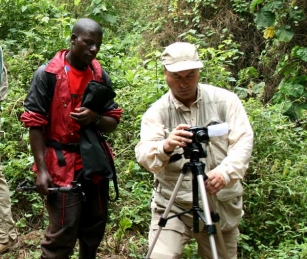
Perry Beeman reporting from Rwanda.
Rwanda faces a range of environment-related challenges, as it continues to recover from genocide 15 years later. President Paul Kagame insists the country's first full-blown international economy be crafted in an eco-sensitive and sustainable way.
I recently reported from around Rwanda on a reporting mission with a grant from the International Reporting Project. The resulting articles and images will include a series in The Des Moines Register.
Here's a look at the key issues:
LAND SHORTAGE
Problem: Rwanda is basically out of land, yet many refugees haven't returned yet after the genocide. Families are large, with as many as eight children. The population, now just shy of 10 million, is expected to grow to nearly 13 million by 2020. Families divide their land into smaller and smaller plots. Overworked soil is losing its growing power.
Solution: The government is looking to shift people to other industries, such as ecotourism, hospitality, information technology and communications. That would allow residents to buy food, rather than grow it, freeing land.
SOIL EROSION, WATER POLLUTION
Problem: The country loses enough soil each year to grow crops for 40,000 people. Rivers are so choked with silt that most stretches have no aquatic life.
Solution: Authorities are working on the country's first land-use plan, and Rwandans will get titles to their land for the first time. Some crop fields will be returned to grasses and trees, or converted to tea, which can hold soil.
In 2000, 90 percent of the population worked in agriculture, a figure expected to fall to 75 percent by sometime next year. The federal government wants to cut that to 50 percent by 2020. Agriculture accounts for about 47 percent of the gross domestic product now, but the federal government wants to cut that to 33 percent by 2020.
POVERTY
Problem: The government reports that 57 percent of Rwandans, most of them women, live in abject poverty, surviving on less than $1 per day.
Solution: The goal is to reduce the percentage of Rwandans living in poverty to 40 percent by next year, and to 30 percent by 2020. How? By pushing for service-oriented jobs in ecotourism, communications, information technology and other non-agricultural fields, and by converting to value-added commercial agricultural operations.
POWER
Problem: Only 2 percent of the population has electricity. The entire country's generation capacity is 72 megawatts, less than the capacity of many single wind farms in the United States. Rwanda's top energy source, by far, is wood. Electricity generation comes largely from hydropower. Imported petroleum is a financial drain.
Solution: The government is pushing for a range of new generation from hydro, solar and methane and is searching for oil and gas reserves. There is talk of wind power. Plans call for liquid propane to replace wood for cooking.
DRINKING WATER
Problem: Tap water is scarce. Even community supplies can be dicey. The government says 70 percent to 80 percent of homes have drinkable water, but that includes anyone who lives within 500 meters of a spot where they can pick up water and haul it home, on their heads, in large containers. A decade ago, 61 percent had drinkable water within 5 kilometers, said Albert Butare, minister of state for water.
Solution: Work continues to bring more water to taps. A new land-use plan should ease massive soil erosion problems caused by subsistence farming on steep slopes. Some hillside areas will be converted to grass or tea to hold soil.
SEWERS
Problem: There are virtually no central sewer systems in Rwanda, and its hills make that impractical in most areas, including Kigali. Most Rwandans use primitive pit latrines, especially in rural areas. It's not much better in the city. In 2006, 5.4 percent of urban households had flush toilets, the government reports. Rwanda plans limited treatment plants, but also improvements in septic systems.
It's a huge issue. The government blames 80 percent of Rwandans' illnesses on polluted water and poor sanitation. A high-profile example of ongoing pollution: An industrial park in the Gikondo-Nyabugogo wetland system sends toxic chemicals into the Nyabarongo River. That stream dumps into the Akagera River, which feeds one of Africa's natural wonders: Lake Victoria in neighboring Uganda, Tanzania and Kenya.
Solution: Rwanda is requiring sewer systems in many new developments. The government is assisting in projects to improve septic systems. The Rwanda government is pushing people to live in settlements, a movement known as "imidugudu," or "living together," in part because of health issues related to sewage pollution.
GARBAGE
Problem: Rwanda has dumps, not landfills. That means polluted water leaches into water supplies. Methane from rotting garbage has started on fire on some sites, threatening residents with toxic fumes.
Solution: The country is moving toward U.S.-style lined landfills. Plans are under way to capture methane from landfills for power production.
ATTRACTING MORE TOURISTS
Problem: Ecotourism is the No. 1 source of outside income in Rwanda. Even then, the potential is largely untapped. The country's offerings are spread across dicey roads. And the Land of a Thousand Hills is largely unknown outside of its famous mountain gorillas.
Solution: The country is rapidly improving its roads, especially those leading to national parks. The Africa Wildlife Foundation joined with others to build a five-star lodge near Volcanoes National Park, home of the mountain gorillas. Workers are completing a new visitor center and a lodge at Nyungwe National Park, which also plans an elevated walkway through the trees. Nyungwe is home to chimpanzees, monkeys, hundreds of species of birds and well-developed trails. The country is getting a good reputation among mountain bikers.
Akagera National Park draws just 17,000 visitors a year to its well-appointed lodge, despite wildlife tours that can turn up elephants, giraffes, hippos, antelope, zebra and a wide range of birds. The park's setting next to Lake Ihema, bordering Tanzania, offers spectacular sunrises, a pool and boat tours around a nearby island. The park is ramping up advertising efforts. The government gave away to returning refugees 1,500 square kilometers of the park after the genocide, leaving about 1,000. There are no plans to increase the park area.
Read Beeman's blogs written while reporting from Rwanda.
More from this Reporter
- Saving Rwanda’s Gishwati Forest
- Rwandan students promote conservation
- Tracking wild chimps through the forest
- Renewal in Rwanda: Multimedia package for The Des Moines Register
- Moments from the trip: Perry Beeman’s reflections
- Much progress made, but many challenges face a post-genocide Rwanda
- President Kagame is committed to environment
- Rwanda works to power up with clean energy
- A new, green day dawns in war-wracked Rwanda
- Inspiration from gorillas leads Iowa businessman to Gishwati project
- Gishwati team an ecletic group
- Fighting for an African forest