Worldview: China’s new generation
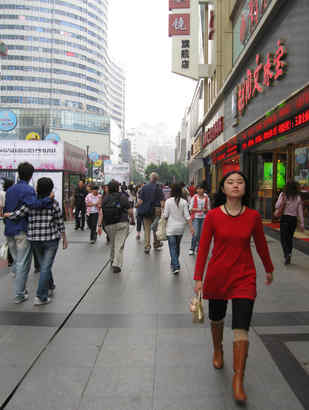
The woman in a red tunic and black leggings, like others of China's sophisticated younger generation, strides down a pedestrian shopping street in Chengdu. She and others her age are a key part of a China facing relentless change.
I saw her stride purposefully down a pedestrian mall in Chengdu in a red tunic and black leggings. And I felt she symbolized one of the most fascinating aspects of today's China - its increasingly sophisticated and urban younger generation.
I never got her name, but she and others like her will shape her country's future. What they want for themselves and for their country will help determine Beijing's relationship with the West.
My talks with students and young people on a recent trip to China gave me brief but fascinating glimpses into this generation's thinking, leaving me hopeful but sobered by China's relentless pace of change.
In 1990, only 26 percent of China lived in and around cities, a figure that has risen to 43 percent in 2010 and is projected to rise to 70 percent by 2030. Estimates of how many have achieved middle-class earning power vary widely, ranging from 150 million to 300 million, and many new urbanites are poor migrant workers. But cities hold the promise of a better life.
In 1986, when I first visited Chengdu, capital of the western province of Sichuan, it was a low-rise market town serving a hinterland newly freed from the communal farm system. Today, Chengdu is a high-rise metropolis, filled with new apartment complexes and top-end stores - and a young middle class.
In leafy downtown Baihuaton Park, young couples haul brightly dressed offspring to compete in a poetry recital. They take their children, wearing panda ears and panda T-shirts, on weekend excursions to the Chengdu Panda Breeding and Research Center. And new Chinese yuppies ("Chuppies"?) buy organic produce from private farmers who once labored in communes.
To probe the thinking of the next generation of Chuppies, I met with a dozen students on the leafy campus of elite Tsinghua University in Beijing. These scholars are selected by merit exam; many come from poor rural backgrounds or families that once lived in one-room government housing but now own comfy apartments.
I was struck by their openness, their knowledge of the world, and their sky-high aspirations. One young woman wants a doctorate in marine biology to work on global-warming issues; others will do graduate work abroad in economics or engineering, but return to China for their careers. Another wants to set up a "liberal school that protects children's nature" like London's Summerhill. Where did she learn about Summerhill? "On the Internet."
Other students at Tsinghua and those I met at Shanghai's Fudan University also say they get their information from the Internet - although "many Western sites are banned" by government censors. They concur that anyone who really wants access can circumvent the censors. One blogger said: "Anyone can leap over China's Great Firewall."
At both universities, I heard students debate the need for Internet censorship: some defended it because the Internet could be "irrational" or spread "rumors" and "panic." Others said more openness was needed to check official corruption.
Yet they all claimed that most young Chinese aren't concerned by the absence of Facebook, Google, or YouTube and are satisfied with copycat Chinese sites. The Chinese government is investing heavily in setting up new social-networking websites with controlled content to meet the growing demand.
Even those I met who do jump the wall said they were mostly satisfied with the performance of their top leaders, and optimistic about their future - with some caveats.
One science major told me, "We are a generation living in an exciting era, but it is also a suffocating era." The one-child policy, she said, put a heavy burden on her and her peers when caring for their parents. She also complained: "This generation is lacking in creativity" and too focused on material gains.
Another Tsinghua student, who "logs on to Twitter every day" said: "There are two Chinas, one side optimistic and one not." On the Internet, he said, "many young people complain about corruption and about growing social unfairness." Others worried about high housing costs and finding jobs.
I found the students less overtly nationalistic than I expected, and curious about the United States. Some were concerned about "omnipotent U.S. culture," but others praised America's openness and wanted to study in the United States.
As for China's role in the world, these students were excited about their country's rise, but uncertain about its future global status. I heard competing visions at Tsinghua:
"China is getting more powerful, that's a good thing."
"I don't want China to play a bigger global role."
"This is a mystery period, like London after the industrial revolution."
But most of the students concurred that China's top priority must be the maintenance of stability, so growth will remain high and the rich-poor gap narrow. That is exactly the Chinese government's position.
China's younger generation, from my tiny sample, seems ready to accept - perhaps with caveats - that careful message from Beijing. Not a generation looking for revolution, but one looking to advance and learn more about the world.
Trudy Rubin visited China on an International Reporting Project Gatekeeper Fellowship.
More from this Reporter
- Worldview: A chance to talk to Chinese
- Worldview: NGOs a paradox in today’s China
- Worldview: Viewing ‘the other China,’ beyond the economic boom
- Worldview: A green movement grows in rural China
- Rio is Town of Two Worlds
- Pragmatism Helps Slow AIDS
- Brazil Battles AIDS and U.S. Resistance