Twilight for a Landmark in Arms Control
Lawmakers press to apply the Nunn-Lugar model to other parts of the planet, but a sense of urgency is lacking.
During the Cold War, the Soviet Union ran a highly developed program to study infectious diseases such as anthrax, the plague and cholera, with an eye toward wiping out U.S. livestock. Now more than 60 years old, one such high-security lab sits decaying a short drive from the largest city in this former Soviet republic. Next door, the site is humming with American engineers and Kazakh workers, toiling away on a hulking, half-finished concrete and steel structure.
When work is complete — in 2015, if all goes as planned — a $100 million U.S.-funded state-of-the-art Central Reference Laboratory will replace the aging Kazakh Scientific Center of Quarantine and Zoonotic Diseases. Kazakhstan hopes the new facility will make it a center for biological research, while the United States hopes it will keep dangerous disease agents, currently housed in a structure built in the 1950s, out of the hands of terrorists.
The Central Reference Laboratory is just one of several high-profile nonproliferation projects the United States and Kazakhstan are wrapping up or have recently completed. All have been conducted under the Cooperative Threat Reduction program, which was instituted by the landmark 1991 law known as Nunn-Lugar for its two lead sponsors — Sens. Richard G. Lugar, a Republican from Indiana, and Sam Nunn, a Georgia Democrat. Drafted as the Cold War was ending, the law funded efforts to destroy or secure the enormous trove of weapons of mass destruction scattered around the former Soviet states. Two decades later, the program is winding down after a long list of successes, none more dramatic than in Kazakhstan, the center of the Soviet nuclear testing program last century.
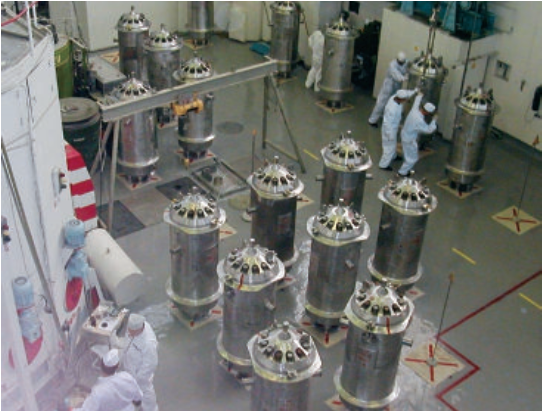
CLEANING UP: The Nunn-Lugar program funded the removal and destruction of huge stocks of Kazakhstan’s nuclear material, including these casks of highly enriched uranium in 2009.
“We can pretty much say we’re in a maintenance mode” when it comes to nuclear-threat reduction in Kazakhstan, says Lt. Col. Charles Carleton, the director of the Pentagon’s Defense Threat Reduction Office in Kazakhstan. That’s true for Nunn-Lugar programs across the former Soviet Union — predominantly in Russia, Ukraine, Belarus and Kazakhstan.
It all points to the end of the era for one of the most consequential pieces of international affairs legislation ever passed by Congress. Given its success, some on Capitol Hill are now pressing to apply the Nunn-Lugar model to other parts of the world where weapons of mass destruction pose a risk, particularly Africa and the Middle East.
But the sense of urgency for securing dangerous material is not what it was two decades ago. Even Syria’s recent use of chemical weapons has failed to galvanize Washington on this front. President Barack Obama continues to rally international support for multilateral nuclear-security efforts, but his own administration reduced its request for the Department of Energy’s nuclear-security budget for fiscal 2014. It doesn’t mean an end to smallerscale U.S. efforts to secure nuclear materials. But policymakers have yet to match the vision or ambition of Nunn-Lugar.
Washington’s inattention is compounded by its fraying relationship with Moscow, which earlier this year refused to renew a bilateral agreement with the United States that has underpinned the two countries’ cooperation related to Soviet-era weapons of mass destruction. The agreement, nonproliferation experts say, was the linchpin of Nunn-Lugar. The United States and Russia did sign a different agreement to allow the two countries’ energy agencies to continue work on securing fissile material, but it’s not nearly as comprehensive.
“This is not the same. This is not Nunn-Lugar, this is not Cooperative Threat Reduction,” says Kenneth N. Luongo, president of the Partnership for Global Security, a think tank focused on nuclear security. “This is what remains of a dismantled effort.”
A Republic Disarmed
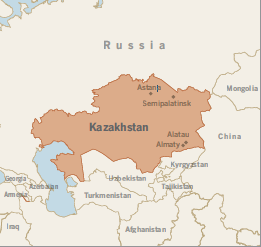
The vast Soviet-era nuclear testing site on the Kazakh steppe known as Semipalatinsk is now “completely safe and secure,” Kazakhstan’s Foreign Minister Erlan A. Idrissov told assembled reporters at a recent briefing in Astana, the country’s gleaming new capital. “There are no loose dangerous materials.”
While some scientists suggest there could be other bits of nuclear material left over from Soviet days, it’s true that Kazakhstan, with the help of the United States and Russia, succeeded in securing a site that was once home to several hundred pounds of plutonium — the remnants of more than 200 underground nuclear tests conducted between 1961 and 1989. It took a gargantuan effort — 17 years of work and roughly $150 million in U.S. funding — to complete the project, which was finalized last year. (Sidebar, p. 1693)
The United States is also teaming with Kazakhstan to transform its nuclear research reactor in Alatau, outside of Almaty, from producing highly enriched uranium — which can be used to make a bomb — to low-enriched uranium. Like the Central Reference Laboratory, that project is slated to finish in 2015.
Idrissov insisted that cooperation between the two countries on nonproliferation remains “necessary” beyond then “because the world is still not secure.”
He emphasized nuclear-security efforts that Obama has championed at the biannual summits he initiated in 2010. The United States and Kazakhstan can collaborate “to make sure that governments are on alert on a permanent basis, there are export control regimes, there are other measures to secure dangerous materials, making them inaccessible to dangerous groups of people.”
“This is a huge agenda,” he continued. “This is not maybe as glamorous as doing away with nuclear weapons, but still it is as important as those efforts.”
That may be true, but critics say there is little leadership on how exactly to move that agenda forward, especially now that the backbone of the previous era in nonproliferation work — cooperation between the United States and Russia — has foundered.
“The real problem with the state of play is that Nunn-Lugar was kind of a core principle in the nonproliferation, nuclear security, nuclear defense kind of area, and now it’s shrunk down to kind of a toothpick,” says Luongo, previously the director of the Office of Arms Control and Nonproliferation at the Department of Energy.
Russia’s decision this summer not to renew the “umbrella agreement” governing bilateral cooperation under Nunn-Lugar came after Russian officials increasingly chafed at what they saw as a paternalistic and invasive arrangement. The Obama administration has played down the agreement’s expiration, insisting the new framework will allow nonproliferation collaboration to continue.
“While our relationship with Russia has evolved” since the early days of Nunn-Lugar, “our mutual interest in nonproliferation and the importance of our cooperation on nuclear security has not changed,” an administration official said in an emailed statement.
The official acknowledges that cooperation will end between the Pentagon and Russia’s Ministry of Defense, which have overseen the destruction of nuclear weapons as well as chemical weapons stockpiles. But that had already been on the wane as projects wrapped up. Recently, the Department of Energy and Russia’s Energy Ministry have played the lead role, focusing on securing weapons-grade nuclear materials and technology.
The official says the administration expects cooperation on nuclear security “to continue for many years into the future.” And some arms control advocates agree that the new agreement is better than nothing. “It’s not your father’s Nunn-Lugar,” says Paul Carroll, program director at the Ploughshares Fund, a foundation that supports work to rid the world of nuclear weapons, but it’s good “there is an agreement in place.”
Luongo says the “biggest loss out of that agreement is the high-level political attention,” which is much diminished given the limited, technical nature of the new pact. The concern among the nonproliferation community, adds Carroll, is “that the nuclear-security aspects of both our federal spending, but more to the point, our federal policy suffers from a lack of not only leadership, but also informed leadership on the Hill.”
Luongo says the administration bears significant blame. “They haven’t really initiated anything new,” he says, only “accelerated activities that were already underway.” Those include efforts to remove small amounts of highly enriched uranium — which can be used to make a bomb — from various countries and to convert research reactors using highly enriched uranium to low-enriched uranium.
Legislative Proposals
A few members of Congress are pushing for a new counterproliferation effort. Sen. Jeanne Shaheen, a New Hampshire Democrat, and Republican Rep. Jeff Fortenberry of Nebraska introduced legislation in their respective chambers that would require the Obama administration to come up with a strategy to apply the Nunn-Lugar model to the Middle East and Africa. The language has been included in the Senate and House defense authorization bills for fiscal 2014. “The Nunn-Lugar initiative has been highly successful and unique in government in that it got beyond the constraints of what already existed,” says Fortenberry, who believes the program “has played an essential role in international stability.”
The “basic idea in the legislation,” he says, is to use Nunn-Lugar “as a template that can be applied in new areas and new circumstances.” Fortenberry has also teamed up with California Democrat Adam B. Schiff to form the Congressional Nuclear Security Working Group. But he laments that there is not nearly enough interest on Capitol Hill in what he believes is a critical national security issue.
“Congress is pulled in so many different directions,” he says. “The ability to give attention to long-range planning needs, geopolitical considerations for a century, are so limited, and there’s no constituency for it, that it impedes the necessary thinking that has to take place in this regard.”
Luongo lauds efforts to expand nonproliferation work beyond Nunn-Lugar’s traditional geographical purview, something that Congress authorized in its fiscal 2008 defense authorization law and that the administration began doing in 2010.
“All of that is to the good,” Luongo says. But the proposal that Shaheen and Fortenberry are backing “is not a defense concept, it’s not a national security strategy, it’s an evolutionary module that you stick onto whatever is existing, which maybe in this environment is the best that you can do,” he laments.
Fortenberry acknowledges that his proposal is just one step toward addressing several deeper questions: “How are we going to build upon our past successes but update and modernize them for changing circumstances? How are we going to carry forward that legacy and actually build upon something good but adjust it to these times?”
One idea that Carroll suggests is for Washington and Moscow to forge a broader relationship, “continued in the spirit of Nunn-Lugar,” but to help mobilize resources and work with third countries on nuclear security in places such as Asia.
The partnership could also be applied to pursue reductions of both countries’ stockpiles of short-range nuclear weapons, which haven’t been addressed in past treaties. “That would be huge,” he says. The administration says it is already promoting such efforts. But Luongo says real progress on that front may be unrealistic given the current tension in U.S.-Russia relations - and dysfunction in Washington.
“The problem,” he says, “is without a regular appropriations and authorization process, it’s very, very difficult” for policymakers “to do anything beyond keeping your head above water.”
Emily Cadei reported from Kazakhstan as a fellow with the International Reporting Project (IRP).
More from this Reporter
From Other Reporters in This Country
Also appeared in…
- Foreign Policy