Deserted women tailor lives
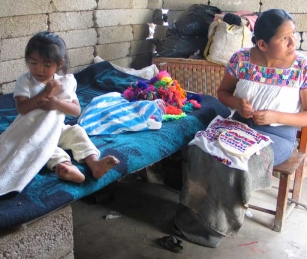
Virginia Bocato de la Pila embroiders while her daughter Mariel plays. She sells blouses, usually one a month.
SAN PABLITO, Mexico -- High in the misty mountains northeast of Mexico City, among the lime and banana trees, Virginia Bocato de la Pila embroiders flowers and multicolored sunbursts onto blouses to support her three daughters.
At 26, she is stitching her life back together.
A bounty from villagers who have left for the United States is filtering into the town of about 3,300, where many homes lack running water and malnutrition remains a big problem. Many men from San Pablito have found work in North Carolina, and their earnings buy phone lines, new houses of gray concrete, refrigerators and school supplies for their families.
But not every man who crosses the border provides a better life for his family.
Bocato de la Pila's husband worked as a house painter in Durham and took other jobs. She says he sent home nothing to support her and the children.
Like Bocato de la Pila, about 70 so-called "madre solteras," or single mothers, live in San Pablito. Many of the women were abandoned by men who went to the United States.
"Men promise to send money, but they slowly stop," said the Rev. Javier Galindo Castro, a priest in the nearby town of Pahuatlán. "I know one mother in San Pablito who received $100 after 15 days. Then another two months passed before she received more money. Then nothing."
North Carolina, and particularly the Triangle, became a destination for men from the region of San Pablito and Pahuatlán in the mid-1990s as they learned they could quickly find work in construction, landscaping and similar jobs. The two towns, about three miles apart in the state of Puebla, are a four-hour bus ride from Mexico City.
Lucia Aparicio Espiritu, 23, has not heard from her husband since he left San Pablito six years ago for North Carolina. He promised to send money for his son but never did, she said in the Otom' language as her friend Maura Zacatenco translated.
She heard through his relatives that he has become involved with another woman and now has two other sons. Even so, she thinks he might return.
"That's her hope," Zacatenco said. "But still, he doesn't come."
Day-to-day struggle
Life is particularly harsh for single mothers in rural areas such as San Pablito, said Professor Olga Lazcano, who directs the Regional Development Center at the University of the Americas Puebla, a private institution southeast of Mexico City. Many have large families, are illiterate and, like Bocato de la Pila, work on labor-intensive crafts without steady pay.
"These are women who fight day to day so their children can have an alternative way of life," Lazcano said.
Bocato de la Pila's one-room shack, a tin roof over wood and concrete blocks, houses her parents and a younger sister, in addition to her and her daughters. They live at the mercy of the elements, soaked by rain and chilled by night. Meals consist of tortillas, beans and bread dipped in milk.
The house has no kitchen, no phone and no bathroom. At the foot of one of two beds fashioned from wood planks and concrete blocks sit the family's only luxuries: a stereo and 12-inch color television beaming movies, cartoons and telenovelas, the Mexican soap operas.
Bocato de la Pila has the cocoa skin, inky eyes and blue-black hair of the Otom' but sees herself in the troubled, lighter-skinned TV stars. She sees her husband, too, and their ill-fated marriage.
"It was like in the telenovelas, because he doesn't love me anymore," she said in the Otom' language as her sister translated.
Bocato de la Pila was 17 when she and Alberto Cienega Zacatenco took their place at the altar of the local Catholic church after the birth of their first daughter. She still has the wrinkled marriage certificate.
Cienega worked the corn and coffee fields with her father and other men. The couple had a second daughter.
"She thought they would live together. That he would take care of her and his children," explained Maura Zacatenco, who translated. "That is what he said." (Maura Zacatenco is not related to Bocato de la Pila's husband.)
Six years ago, after the Mexican peso crisis devastated the economy, Bocato de la Pila's husband suddenly left for Durham.
She had little recourse. Without legal resources, tracking down men across the border is nearly impossible.
"There are laws, but the men, they will not comply," said Lazcano, the professor. "The women do not know where they are. There are women here who do not know what the United States is, what the distance is between New York and Florida."
To support her children, Bocato de la Pila sewed. It was a skill she taught herself at age 10 after dropping out of school.
After her husband left, she met another man who, she said, promised to take care of her. But she said he moved to another town when she became pregnant, abandoning her and their daughter.
Then one day Alberto Cienega Zacatenco returned to San Pablito -- to live with another woman. Bocato de la Pila saw him while she was walking with his daughters.
He never spoke.
"The girls miss him, but he told me he did not want them," she said.
Cienega, 27, lives in the hills above San Pablito, where he brought back a 14-inch television and enough money to set up house with his second wife.
Church and Mexican law do not allow more than one marriage at a time. But Cienega said he and his second wife had a civil ceremony. Three years ago she bore him a son. Another baby is due this month.
Bocato de la Pila always wanted money, Cienega said. "But I didn't give her any," he said.
He said he refuses to help her because she had a child by another man.
Cienega keeps his North Carolina identification card in his wallet and plans to return to Durham this year. Work is scarce in San Pablito, but a job as a house painter is easy to find in Durham, he said.
"I want to go live there with my family," he said, referring to his second family.
Women craft solution
Church leaders blame an erosion of values, rather than emigration, for the abandonments. "The problem is temptation," said the Rev. Salomon Sarmiento, 40, a Pahuatlán priest. "We need to teach the people, men and women, to resist."
The abandoned women in San Pablito have another solution: Economic independence. A few years ago, they organized to send their crafts to the United States for sale.
Bocato de la Pila usually sells one embroidered blouse a month for 400 pesos, about $40. She earns about $1.80 a day pounding bark into "papel amate," a kind of paper sold to tourists. It is barely enough to cover food and school supplies for her oldest daughter.
Bocato de la Pila dreams about working in the United States. The migrant stream is still largely male, but professor Lazcano said local single mothers have begun to join the migration.
Crossing the border would be expensive for Bocato de la Pila. She would have to find a way to pay for the two-day trip to the "frontera," or border region. Then she would have to to pay the fee of the "coyote," or smuggler. Unlike her husband, who said he paid about $1,300 to cross the Arizona desert, she would have to pay twice -- for herself and for her children.
She could never leave them.
More from this Reporter
- Climbing Mexico’s magical wonders
- Working to sell Mexico as a market
- N.C. recruiter gets jobs for Mexicans