

|
|
|
|
|
|
|
|
|
|
|
|
|
|
Recent Seminar Highlights
seminar highlights from previous sessions
Sunni-Shi’ite Quarrels Could Haunt Middle East for Years, Says Lebanese Analyst
Paul Salem |
WASHINGTON, February 7, 2007 — For journalists and academics, sectarian violence in the Middle East is a current preoccupation, and with good reason, warns Paul Salem, director of the Carnegie Middle East Center in Lebanon. Salem addressed an intimate group of SAIS students and IRP fellows and discussed, "the war of the roses in the Middle East," his term for Sunni vs. Shiite violence that could rage on for decades. Reminding his audience that Sunni/Shiite sectarian strife had been largely dormant for nearly five centuries, Salem cautioned that the Iraq War is stirring sectarian tensions so vigorously in Iraq that they have the potential to boil over into neighboring Arab states like Syria, Lebanon, Bahrain and Saudi Arabia.
Salem also analyzed the failure of democratization in the Arab world. "The US has in the back of its mind the World War II and Cold War Experience," he said, where the US wages war against an evil dictator and by removing him, society naturally replaces authoritarian rule with democracy. Salem is adamant that this method won't work in the Middle East. more »
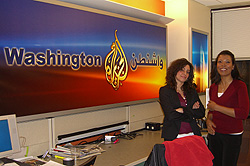
IRP Fellows Visit Al Jazeera International in Washington, DC
 |
|
Spring 2007 IRP Fellows Nikole Killion and Shereen Meraji at the Al Jazeera Arabic Washington, DC bureau. |
WASHINGTON, February 12, 2007 � Spring 2007 IRP Fellows toured the Al Jazeera English studios and the Al Jazeera Arabic Washington, DC bureau. more »
Immigration to the US is Likely to Increase in Coming Years, says Immigration Expert
 |
|
Susan Martin |
WASHINGTON, February 8, 2007 � The two major trends that will define immigration for the next several decades are a movement from north to south – from developing to developed countries – and an increasing number of female migrants, said Susan F. Martin, director of Georgetown University’s Institute for the Study of International Migration, in a talk with IRP fellows and SAIS students.
Economic disparity is the main factor fueling migration. With the gap between rich and poor countries widening, Martin expects migration to increase. Conflict and political instability also drive people to leave their homeland in search of greater security. For women, economic and security-related issues are also pushing more women to migrate, but there are also human rights and gender issues in play. “South African nurses migrate for a working environment in which they’re respected,” Martin said. more »
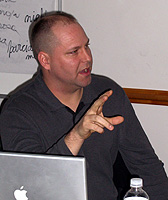
Reporters Need to Take a Multimedia Approach to News, says MediaStorm.org Founder
 |
|
Brian Storm |
WASHINGTON, February 7, 2007 � To say that Brian Storm is bullish on multimedia reporting is a woeful understatement. Storm, the president of MediaStorm is convinced that multi-platform storytelling - marrying photojournalism, audio and video to create a uniquely evocative narrative - will prevail over traditional (single media) journalism.
“The game,” he said,” is changing.”
Storm spoke to a group of IRP Fellows and SAIS students at the latest in a series of IRP brownbag lunches that have explored the changing news media landscape.
“Words alone are not enough anymore. It’s not going to cut it, ” he proclaimed. He emphasized the power of visual images and sound, showing several examples. “The emotion of a photograph brings more to a scene than any number of words could ever say. And voices tell us so much about people. Adding audio to stories gives our subjects a voice.” more »
Pam Constable |
WASHINGTON, February 6, 2007 -- Government corruption, not the Taliban, could be the greatest threat to Afghanistan. Afghans are increasingly alienated from a government they perceive as weak and corrupt at all levels, says Pamela Constable, former Kabul bureau chief for the Washington Post. Constable addressed the SAIS community and the spring 2007 IRP Fellows in a forum sponsored by the International Reporting Project.
She said that while the insurgency does pose massive obstacles to security and development, the country "is not divided against itself," and the insurgency "is not going to overthrow the government. This is not Iraq." But she stressed that Aghanistan's real weakness was lack of honest government. more »
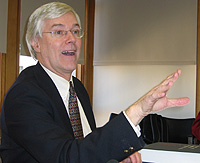
Global Health Expert Cites Economic Costs of Infectious Diseases
 |
|
Thomas Quinn |
WASHINGTON, February 5, 2007 � All it takes is one person to spread an epidemic. And the outcome could be catastrophic not only on a country’s public health system but also to their economy, according to Dr. Thomas Quinn, Director of the Johns Hopkins Center for Global Health.
During a presentation to the International Reporting Project (IRP) Fellows and SAIS community, Quinn highlighted the high economic toll infectious diseases can have on local economies, and even the global economy.
He pointed to the example of SARS (Severe Acute Respiratory Syndrome), a highly contagious respiratory disease that drew headlines after killing more than 700 people worldwide in 2003. Quinn explained that the virus emerged when an individual from Guangdong Province in China came into contact with several people at a Hong Kong hotel where more than a dozen people later became infected. more »
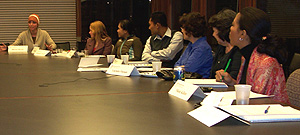
International Journalists Reflect on Toughest Assignment, Offer Tips to IRP Fellows
 |
|
IRP Fellows and University of Maryland Humphrey Fellows meet at SAIS. |
WASHINGTON, February 2, 2007 -- Death threats, deceptive government officials and dangerous encounters are among the many challenges that a group of distinguished international journalists candidly spoke about during a meeting with the International Reporting Project (IRP) Fellows. The journalists, who represented eight countries in West Africa, Eastern Europe and Southeast Asia, are Hubert H. Humphrey Fellows at the University of Maryland.
Melhem, who also contributes to the Kuwaiti daily Al-Qabas and France’s Radio Monte Carlo, was joined by José Díaz Briseño, Washington correspondent for Reforma, a Mexican daily, and Christian Wernicke, the U.S. correspondent for the leading German newspaper Sueddeutsche Zeitung. more »
Widespread Anti-Americanism Complicates Job of Foreign Journalists in the United States
Foreign corresponents (left to right) Christian Wernicke of Sueddeutsche Zeitung, José Díaz Briseño of Reforma, and Hisham Melhem of An-Nahar. |
WASHINGTON, January 31, 2007 — “In the minds of many editors, the line between being critical of the US and being hostile towards the US has been blurred,” said Hisham Melhem, the Washington correspondent for An-Nahar, a leading Lebanese daily, and host of a talk show on al-Arabiya, an arab satellite television station. Creeping and intensifying anti-American sentiment, increasingly familiar to many Washington-based foreign correspondents, provided the topic for an IRP seminar attended by the spring 2007 IRP Fellows and members of the SAIS community.
Melhem, who also contributes to the Kuwaiti daily Al-Qabas and France’s Radio Monte Carlo, was joined by José Díaz Briseño, Washington correspondent for Reforma, a Mexican daily, and Christian Wernicke, the U.S. correspondent for the leading German newspaper Sueddeutsche Zeitung. more »
Africa Important to Wide Array of US Strategic Interests, says SAIS Africa Expert
Peter Lewis |
WASHINGTON, January 31, 2007 — Next time someone asks why Americans – particularly American journalists – should care about Africa, take a page from the playbook of SAIS African Studies director Peter Lewis.
Point out – as Lewis did at a lunchtime seminar for IRP fellows and the SAIS community – that the U.S. gets 15 to 18 percent of its oil and gas from Africa, a number that will likely rise to 25 percent by the end of 2008. Say that Africa has the third largest proven oil reserves in the world, after South America and the Middle East, and that the 48 states of sub-Saharan Africa are home to 450 million Christians, 350 million Muslims and 60 percent of the world’s HIV cases, placing Africa at the heart of global trends in religion and public health. more »
Journalists Should Seize Opportunities to Experiment in a Changing Market, says Tom Bettag, Executive Producer of Discovery Networks
Tom Bettag |
WASHINGTON, January 24, 2007 -- A visit to newsrooms today, says Tom Bettag, former executive producer for ABC News’ “Nightline” and current executive producer at Discovery Networks, is like a trip to the Wailing Wall. With news organizations downsizing, closing foreign bureaus and cutting already lean budgets, and with many flagship newspapers up for sale, many journalists in all media are anxious about the future.
“There is this pall over journalism that is absolutely unwarranted,” Bettag maintains. “If anything – and I’ve done this for 40 years – this is the most exciting time to be in journalism by far.”
In a presentation to the IRP Fellows and SAIS community on the future of broadcast journalism, Bettag sought to put journalists’ current anxieties into perspective. more »
Global Warming May Hit Developing Nations Hard, says Climate Change Scientist
 |
|
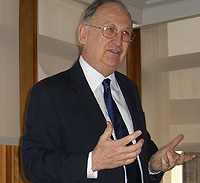
Michael MacCracken |
WASHINGTON, January 22, 2007 � Developing nations contribute only a small fraction of the world’s carbon dioxide emissions, but they stand to suffer greatly from climate change, said Michael MacCracken, Chief Scientist for Climate Change Programs at the Climate Institute, at an IRP seminar for the spring 2007 IRP Fellows and SAIS students. Of all the effects of climate change, shifting water resources could have the most profound impact on developing countries. Increased evaporation rates from global warming will make dry areas more arid and precipitation elsewhere more intense. Global warming could also bring more violent storms, destroy existing ecosystems, and increase infectious diseases, while shifting climate zones could disrupt global commodity markets.
From 1993-2002, MacCracken served as executive director and senior global change scientist with the interagency Office of the U.S. Global Change Research Program (USGCRP). He participates in numerous international scientific expert groups that measure and try to address the impact of climate change. more »
Award-Winning Women Journalists from China and Mexico Fight for Press Freedom
Gao Yu (left) and Elena Poniatowska Amor (right) |
WASHINGTON, October 26, 2006 — Two very different women journalists, one from China and the other from Mexico, came to the Johns Hopkins School of Advanced International Studies (SAIS) to speak about the challenges facing the media and working women in their respective countries.
The two journalists are among four from different countries to be honored with awards from the International Women’s Media Foundation (IWMF). Elena Poniatowska Amor, 74, a Mexican journalist and author known for her dedication to the promotion of equality and human rights, is the recipient of IWMF’s “Lifetime Achievement Award.” Gao Yu, 62, an economic and political reporter from China who has been twice jailed for her commitment to democratic values and continuous struggle against censorship, is a recipient of the “Courage in Journalism Award.” more »
Africans Need to Look Inward to Address the Continent’s Problems
George Ayittey |
WASHINGTON, October 3, 2006 — "African solutions for African problems." That phrase sums up the prescription Ghanaian-born economist George Ayittey believes can form the basis for promoting development on the African continent.
Speaking at a seminar for the fall 2006 International Reporting Project Fellows and students at The Johns Hopkins University’s School of Advanced International Studies (SAIS), Ayittey gave an impassioned lecture on the failure of African leaders to build democratic, prosperous societies in the decades since they gained independence. He said many governments in Africa are governments in name only. Instead of working for the well being of their people, many are actually simply "vampire states," governments that have been "hijacked" by a small group of powerful people for their own personal gain. more »
| Matt O'Neill |
WASHINGTON, September 27, 2006 � Filmmaker and former IRP Fellow Matt O’Neill said he hopes his documentary “Baghdad ER” shows viewers the “heroism and high-stakes horror” of war. He spoke in a question-and-answer session following a special screening of his award-winning HBO documentary to the fall 2006 IRP Fellows and members of the public.
“Baghdad ER” explores daily life inside the emergency room of the 86th Combat Support Hospital in Baghdad Iraq. For two months in 2005, O’Neill and his co-producer and co-director Jon Alpert of the Downtown Community Television Center in New York lived alongside the 86th Combat Support hospital team. The film focuses on the medical treatment of U.S. soldiers inside the hospital, interweaving gruesome surgical scenes with those of a soldier breaking news of his injuries to his mother, a priest praying over dead or dying soldiers, and doctors and nurses describing their daily travails and rewards. more »
IRP Fellows and World Press Institute Journalists Share Notes on Toughest Reporting Challenges
IRP Fellow Eva Sanchis (right) writes for El Diario-La Prensa in New York. |
WASHINGTON, September 27, 2006 — Ten international journalists from the World Press Institute (WPI) and the eight U.S. journalists in the International Reporting Project met today to discuss their most challenging stories at a roundtable meeting at Johns Hopkins University School of Advanced International Studies (SAIS), the home of the IRP Fellowships.
Rusudan Tsereteli, a WPI Fellow who is editor-in-chief of the independent newspaper Rustavi-Info in the former Soviet republic of Georgia, launched the discussion by observing that reporters in countries like hers which restrict press freedom must be willing to take great risks. Tsereteli said she once received a phone call from a person threatening to kidnap her son if she reported a story exposing a corrupt cabinet member. After sending her son and her mother into hiding in another city, she published the article anyway and distributed the issue for free. more »
Latin America's Failure to Distribute its Wealth Fuels its Lefward Turn
 |
|
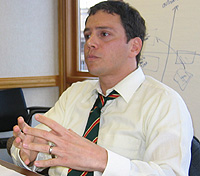
Francisco González |
WASHINGTON, September 14, 2006 — Despite Latin America’s recent impressive economic growth, widespread poverty and skewed income distribution is fueling the rise of left-wing governments across the region, said Associate Professor Francisco González of SAIS’ Western Hemisphere Studies department. In a talk to the fall 2006 International Reporting Project Fellows, González explored the reasons for this leftward turn, which comes as regional economies are booming.
In the past three years, said González, Latin American economies have performed better than at any other time since the early 1970s. They have largely tamed inflation, which wreaked havoc for decades. But Latin America still has, in González’s words, one of “the most skewed distributions of wealth and income in the world.” In particular, he cited the example of Brazil, comparing its “obscene” distribution of wealth to that of the Democratic Republic of Congo in Africa. more »
Early Missteps Crippled US Efforts to Rebuild Iraq
 |
|
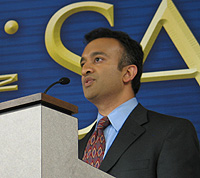
Rajiv Chandrasekaran |
WASHINGTON, September 20, 2006 � The United States might have “pulled it off” in Iraq had it not been for a series of missteps by the Bush Administration and the Coalition Provisional Authority (CPA), said Rajiv Chandrasekaran, The Washington Post’s former Baghdad bureau chief, at a lecture today sponsored by the International Reporting Project (IRP) at the Johns Hopkins University’s School of Advanced International Studies (SAIS).
Chandrasekaran appeared at SAIS to discuss his new book Imperial Life in the Emerald City: Inside Iraq’s Green Zone, which examines the people and policies behind Iraq’s reconstruction effort. Now an assistant managing editor at The Post, Chandrasekaran wrote the book when he was the IRP Journalist-in-Residence in 2005 following an 18-month stint as the paper’s Baghdad bureau chief. more »
Reporters Should Seek Out Lesser Known Sources to Understand US Foreign Policy
| James Mann |
WASHINGTON, September 19, 2006 � Reporters seeking to understand American foreign policy decisions should be leery of relying on “big names” in Washington for information and should start focus on sources at embassies, think tanks, foreign media outlets and the government bureaucracy for foreign policy stories, longtime Los Angeles Times diplomatic correspondent James Mann told the Fall 2006 International Reporting Project Fellows today.
“There is an extraordinary over-emphasis on the ‘talk show world’ here,” said Mann, an Author-in-Residence at the Foreign Policy Institute of the Johns Hopkins University’s School of Advanced International Studies (SAIS), referring to the circle of well-known administration officials and pundits who frequently appear on television, the lecture circuit, or in the White House press room. “You might think Tony Snow or Ari Fleischer is important,” he said, referring to two official White House spokesmen. “Really, they are irrelevant.” more »
HIV/AIDS Declines in Some Regions, But is Poised to Take Off in Others
 |
|
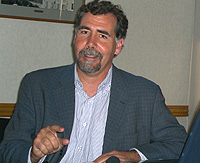
Chris Beyrer |
WASHINGTON, September 14, 2006 � The spread of HIV/AIDS has peaked or gone into decline in some regions, but epidemics may just be beginning in other parts of the world, said Dr. Chris Beyrer, Director of Johns Hopkins Fogarty AIDS International Training and Research Program and an associate professor of epidemiology at the Johns Hopkins University Bloomberg School of Public Health.
In a talk to IRP Fellows and SAIS students, Beyrer presented a somewhat hopeful but still mixed picture on progress made in the global fight against HIV/AIDS. Beyrer has studied the global spread of HIV/AIDS since it was first diagnosed in the early 1980s, and is the author of War in the Blood: Sex, Politics, and AIDS in Southeast Asia. more »
China’s Rapid Growth Increases Social Tensions
 |
|
Minxin Pei |
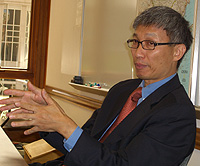
WASHINGTON, September 12, 2006 � The consensus for economic growth in China is breaking down and could have grave consequences for China’s social stability, said Minxin Pei, the director of the China Program at the Carnegie Endowment for International Peace in Washington D.C. He spoke Tuesday afternoon during an International Reporting Project talk attended by members of the SAIS community.
Pei said the societal coalition that supported Deng Xiaoping in opening up China’s economy nearly 30 years ago has fragmented. The peasants and workers have become jaded as the economic inequities between urban and rural regions widen, Pei said, and basic health care and education grow increasingly out of reach for ordinary Chinese. “This single-minded focus on economic growth has resulted in huge imbalances in Chinese society,” he said. more »
Copyright © 2007 International Reporting Project. All Rights Reserved.