

|
|
|
|
|
|
|
|
|
|
|
|
|
|

U.S. Needs to Adopt a Different Approach to Foreign Policy Challenges, says Head of Council on Foreign Relations
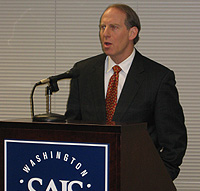
WASHINGTON, February 9, 2006 � The United States is facing daunting international challenges at a time when it has allowed itself to become weaker and should adopt a more multilateral approach to global issues, Richard Haass, president of the Council on Foreign Relations, said at a talk here today cosponsored by the International Reporting Project and the SAIS Foreign Relations Club.
 |
|
| Richard Haass |
“I can't think of another time when there were so many difficult challenges filling the foreign policy plate at any one time,” said Haass, who served in the National Security Council under the first President George Bush, and in the State Department under President George W. Bush.
Haass cited a litany of foreign policy challenges confronting the current administration that included the threat of an avian flu pandemic, terrorism, drugs, global climate change, the current HIV-AIDS pandemic, and the spread of weapons of mass destruction. “The characteristic challenges of this era essentially stem from the dark side of globalization,” said Haass.
He mentioned five areas of weakness that are hampering the ability of the U.S. to respond effectively to these global problems: U.S. fiscal deficits, the Iraq war (which he said has stretched the U.S. militarily), the country’s excessive dependence on imported energy, overall U.S. global competitiveness, and a polarized and divided domestic polity.
Haass said the Bush Administration needs to adopt a more “integrationist” foreign policy, a subject he discusses in detail in his recent book "The Opportunity." He contends that the Administration’s preference for unilateral action and regime change has demonstrated its limitations.
Under an “integrationist” approach, the U.S. would join with great powers such as Europe, China, Russia, India and Japan and build new international arrangements to deal with pressing problems. Haass said he thinks this strategy would also help incorporate the have-nots of the world, the “one third of the people on the planet who are missing out [on the benefits of globalization], who are living on two dollars a day," into the international community. Finally, he contends that an international collective effort could persuade pariah states such as Iran and North Korea to improve their behavior.
Haass noted that when the attacks on 9-11 occurred, the Bush administration initially responded with some collective responses on terror. But, he added, “they haven't used it terribly effectively. There was not nearly the sort of international integration that there could have been over the last four of five years.” He believes that time may be running out for the U.S. to turn these foreign policy challenges to its advantage. “I’m not sure there’s a tipping point, but the window [isn’t] getting wider,” Haass said. “It’s hard to see, given current trajectories, how foreign policy choices are going to improve.”
Copyright © 2005 International Reporting Project. All Rights Reserved.