

|
|
|
|
|
|
|
|
|
|
|
|
|
|
U.S. Still Vulnerable to Terrorist Attack,
Experts Tell Journalists at IRP Workshop
"Covering Homeland Security" Reporting Institute on May 20-23, 2007
 |
|
|
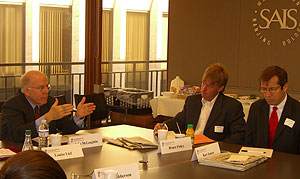
Former CIA Deputy Director John McLaughlin talks to reporters
during the IRP's "Covering Homeland Security" workshop. |
WASHINGTON – Nearly six years after 9/11, the United States is better prepared against terrorism but remains vulnerable to another large attack inside its borders, according to leading experts on homeland security issues who were interviewed by 15 journalists at a workshop organized by the International Reporting Project (IRP).
Top officials and experts such as Secretary of Homeland Security Michael Chertoff, former 9/11 Commission Vice-Chairman Lee Hamilton, former CIA Deputy Director John McLaughlin and others met with 15 journalists from print, radio and TV organizations who participated in the three and a half-day IRP McCormick Tribune Foundation Specialized Reporting Institute held in Washington, D.C. May 20-23.
In unusually candid, on-the-record sessions with top officials of the FBI, the National Counterterrorism Center, the FBI, the Department of Homeland Security, members of Congress and private sector experts, the journalists probed changes in the country’s intelligence gathering and emergency preparedness following the September 11, 2001 attacks on New York and Washington. They also explored issues of specific interest to their communities, such as border crossing from Mexico and Canada and about the concerns of local law enforcement officials.
“We’ve improved the odds, but the odds still favor the terrorists,” said John McLaughlin, the former acting director of the Central Intelligence Agency and currently a Senior Fellow in the Merrill Center for Strategic Studies at the School of Advanced International Studies (SAIS) of The Johns Hopkins University in Washington, D.C.
The IRP, which is based at SAIS, organized the workshop with the support of the McCormick Tribune Foundation in Chicago. Many of the selected journalists, who included 14 reporters and one editor, cover homeland security issues as part of their regular beats at their news organizations.
 |
|
|
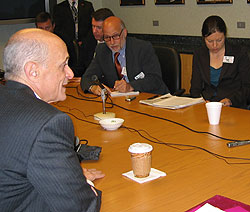
Secretary of the Department of Homeland Security Michael Chertoff speaks with journalists.
|
Michael Chertoff, the secretary of the Department of Homeland Security, defended the work of his agency, which was created after 9/11 by combining 22 separate agencies, while acknowledging that it needed time to “mature” and do a better job of “integrating” the work of the various agencies. During the meeting with the journalists, Chertoff announced new regulations for tighter scrutiny of small, non-commercial aircraft and pleasure boats entering the United States.
The journalists also traveled to an “undisclosed location” outside Washington to meet with Michael Leiter, the principal deputy director, and other officials of the National Counterterrorism Center, the agency that was set up after 9/11 to coordinate intelligence gathering among federal agencies. The group also met with Philip Mudd, one of the leading officials of the FBI’s new National Security Branch, and FBI Public Affairs Director John Miller to discuss that agency’s increased responsibilities for intelligence gathering and counterterrorism.
In addition, the reporters interviewed U.S. Rep. Bennie Thompson (D-MS), the chair of the House Committee on Homeland Security; Cathy Lanier, the Washington D.C. police chief; Norman Rabkin, the managing director for Homeland Security issues for the U.S. Government Accountability Office; Paul Pillar, a former CIA officer and now a professor at Georgetown University, and Daniel Prieto, an expert on homeland security and critical infrastructure issues at the Reform Institute. The participants also had an informal session on “best practices” for reporting on homeland security issues with four senior Washington-based journalists who regularly cover the topic.
At the conclusion of the workshop, participants met with Lee Hamilton, the president of the Woodrow Wilson International Center for Scholars who co-chaired the 9/11 Commission that recommended the restructuring of the country’s intelligence-gathering system that the workshop had explored. In a wide-ranging discussion, Hamilton said intelligence analysis has improved in the past five years but said he believed there is a “serious” problem with the “politicization of intelligence” and with intelligence sharing.
Hamilton said the Department of Homeland Security needs effective executive leadership, a unified headquarters and has “a long, long way to go to becoming an effective department.” He described the FBI’s new role as an intelligence-analyzing agency as a “work in progress,” saying it was taking time to “change the culture” inside what has always been primarily a law-enforcement agency. Hamilton, a former Democratic congressman from Indiana, also said he was concerned by a “deterioration of civil liberties” in the name of protecting the country’s homeland security.
 |
|
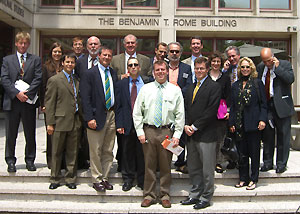
Journalists attending the "Covering Homeland Security" workshop gather at SAIS. |
Participating in the workshop were, in alphabetical order:
David Bowermaster, federal courts reporter, Seattle Times
Dan Browning, federal government reporter, Star Tribune (Minneapolis)
John Diedrich, federal reporter, Milwaukee Journal Sentinel
Matthew Dolan, federal reporter, Baltimore Sun
Bruce Finley, staff writer, Denver Post
Mike Francis, associate editor, The Oregonian (Portland)
Sean Harder, military affairs reporter, Savannah Morning News
Bart Jansen, Washington bureau chief, Portland (ME) Press Herald
Alexandra Marks, NY correspondent, Christian Science Monitor
Michael Matza, staff writer, Philadelphia Inquirer
Cyrus Musiker, reporter, KQED-FM, San Francisco
Solana Pyne, criminal justice reporter, NY 1 News
Tod Robberson, staff writer/international news, Dallas Morning News
Peter Sampson, federal justice reporter, The (Bergen) Record
John Stark, reporter, Bellingham (WA) Herald
About the International Reporting Project
The IRP is situated in downtown Washington at The Johns Hopkins University's School of Advanced International Studies (SAIS). The graduate school, recently voted one of the top schools in international affairs in the country, is home to world-class scholars and experts in a variety of defense-related issues. The IRP is uniquely qualified to provide journalists with the background they need to better explain homeland security issues to the public. Since 1998, the IRP has trained hundreds of U.S. journalists in topics on international issues through a variety of fellowships and other opportunities.
 |
About the McCormick Tribune Foundation
The McCormick Tribune Foundation is a nonprofit organization committed to making life better for our children, communities and country. Through its charitable grantmaking programs, Cantigny Park and Golf, Cantigny First Division Foundation and the
McCormick Tribune Freedom Museum, the Foundation is able to positively impact people’s lives and stay true to its mission of advancing the ideals of a free, democratic society. The Foundation is an independent nonprofit, separate from the Tribune Co., with substantial holdings in the Tribune Co. For more information, please visit our Web site www.McCormickTribune.org
Copyright © 2007 International Reporting Project. All Rights Reserved.