

|
|
|
|
|
|
|
|
|
|
|
|
|
|

Reporters Need to Take a Multimedia Approach to News, says MediaStorm.org Founder
 |
|
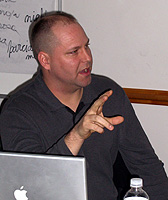
| Brian Storm |
WASHINGTON, February 7, 2007 � To say that Brian Storm is bullish on multimedia reporting is a woeful understatement. Storm, the president of MediaStorm is convinced that multi-platform storytelling - marrying photojournalism, audio and video to create a uniquely evocative narrative - will prevail over traditional (single media) journalism.
“The game,” he said,” is changing.”
Storm spoke to a group of IRP Fellows and SAIS students at the latest in a series of IRP brownbag lunches that have explored the changing news media landscape.
“Words alone are not enough anymore. It’s not going to cut it, ” he proclaimed. He emphasized the power of visual images and sound, showing several examples. “The emotion of a photograph brings more to a scene than any number of words could ever say. And voices tell us so much about people. Adding audio to stories gives our subjects a voice.”
Storm, a former director of multimedia for MSNBC.com and former vice president of News, Multimedia & Assignment Services for Corbis, a digital media agency owned by Microsoft founder Bill Gates, is a fervent believer in the power of multimedia stories both to gain an audience and make money.
He says his New York-based multimedia production company Mediastorm.org has gained the attention of readers and advertisers alike with projects including “Bloodline: AIDS and Family,” and “Kingsley’s Crossing,” the haunting story of a Cameroonian man’s desperate attempt to immigrate to Europe. He is planning to offer these and other documentaries for sale on iTunes.
He urged print, radio and video reporters to move beyond their chosen discipline and learn new skills, or collaborate with other journalists who have those skills to produce reporting that features visuals, sound, and narrative text.
The key, he maintains, will be quality.
An enthusiastic booster of long-form journalism, Storm reports that early in his career, he faced a frustration familiar to any writer or photographer. News organizations often weren’t willing to dedicate the resources to create in-depth pieces, and even when a photographer was sent off on a lengthy assignment, only a fraction of the shots would end up in print. There were beautiful pictures to be shared, and amazing stories to be told, but they weren’t reaching an audience.
Enter multimedia reporting, which, Storm says, allows photographers to be authors, and allows writers to add new fullness to their stories. And, he adds, it's cost-effective: He cites an example of one story, shot and recorded by a single photographer, that was sold to a print publication, its online subsidiary and a separate broadcast network.
“It’s crystal clear where the future of media is,” Storm says. “It’s in this space," (he gestures at his high-end Macintosh, of which he is outspokenly enamored). “You are going to be able to watch what you want, when you want, and how you want.”
He believes the Internet news media market will place a much higher value on multimedia “packages.” Rather than aiming for a broad, general audience, Internet news sites will concentrate more on “affinity groups” – individuals who share an interest in a particular subject, and will rely more heavily on “viral” distribution – stories and links that friends email to each other.
Of course, this new vision of reporting also requires training and investment, both by media companies and their employees. Anyone who balks at the commitment should remember this new wave is coming, Storm warns. “The new generation of reporters has already embraced multimedia.”
Copyright © 2007 International Reporting Project. All Rights Reserved.