

|
|
|
|
|
|
|
|
|
|
|
|
|
|

International Journalists Reflect on Toughest Assignment, Offer Tips to IRP Fellows
 |
|
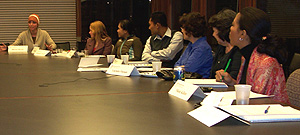
| IRP Fellows and University of Maryland Humphrey Fellows meet at SAIS. |
WASHINGTON, February 2, 2007 -- Death threats, deceptive government officials and dangerous encounters are among the many challenges that a group of distinguished international journalists candidly spoke about during a meeting with the International Reporting Project (IRP) Fellows. The journalists, who represented eight countries in West Africa, Eastern Europe and Southeast Asia, are Hubert H. Humphrey Fellows at the University of Maryland.
Anita Shah Lakyary, a writer and television presenter in Pakistan, said she and her family became targets of a terrorist group after she wrote a critical story about their intimidation tactics at a school in her home province. Lakyary said that the group harassed her family and had threatened to shoot her.
"It was unthinkable to write against them," said Lakyary, who said her editors were initially afraid to publish the story. "But I told them [editors], I will get it published in my name....I will face them [the terrorists] if they want to shoot me."
Zahid Hossain, a reporter/editor from Bangladesh, discussed the challenges that he encountered when he was investigating the illegal detention of youths at a local adult prison. During his investigation, he discovered that up to 400 juveniles were being imprisoned but he was unable to corroborate the story with government authorities.
"We have difficulties to get this type of information in Bangladesh...because there are laws that protect the information of the government," Hossain said, referencing the country's Official Secrets Act, which has restricted press freedom for more than 80 years. "We have to fight with our sources for access."
The Humphrey Fellows, who are spending the year studying various media programs at the Philip Merrill College of Journalism, also shared their impressions of American journalism and its coverage of foreign news.
"I have talked to many Americans here and many of them have the wrong perception of what is happening," said Hamida Aman, referring to news stories about her native Afghanistan, where she owns a production company. "Americans are so far away (from Afghanistan), and they tend to focus on the same topics and even those are sometimes wrong. Even the obvious, like womens' rights or poppies, people don't know exactly what they are about."
Bridgette Che-Fomunyam, a programming chief at Cameroon Radio and Television, said she also notices a lack of in-depth coverage about the African continent.
"When they [Western media] show Africa, it's always the same picture on the air," said Che-Fomunyam, describing the frequent use of footage depicting malnourished children. "Africa is not all about hunger and AIDS. There are good things there too. We live a normal life just like everyone else."
Many of the journalists advised the IRP Fellows to approach their reporting projects with an open mind and to seek out reliable sources on the ground, such as through a local journalist organization.
"Find a journalist that you trust very much who knows the field," said Jakarta Post manager A'an Suryana. "If you don't find the right person, they will mislead you and it will be very dangerous."
Abdoulaye Ibbo-Daddy, a veteran journalist who now owns his own multi-media company in Niger, emphasized the importance of being perceptive in the field and not limiting oneself to a specific story idea or topic.
"When you go, open your eyes and maybe the best stories will come," he said.
Copyright © 2007 International Reporting Project. All Rights Reserved.