

|
|
|
|
|
|
|
|
|
|
|
|
|
|

Early Missteps Crippled US Efforts to Rebuild Iraq
 |
|
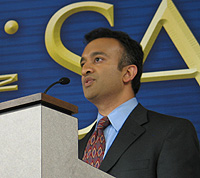
| Rajiv Chandrasekaran |
WASHINGTON, September 20, 2006 � The United States might have “pulled it off” in Iraq had it not been for a series of missteps by the Bush Administration and the Coalition Provisional Authority (CPA), said Rajiv Chandrasekaran, The Washington Post’s former Baghdad bureau chief, at a lecture today sponsored by the International Reporting Project (IRP) at the Johns Hopkins University’s School of Advanced International Studies (SAIS).
Chandrasekaran appeared at SAIS to discuss his new book Imperial Life in the Emerald City: Inside Iraq’s Green Zone, which examines the people and policies behind Iraq’s reconstruction effort. Now an assistant managing editor at The Post, Chandrasekaran wrote the book when he was the IRP Journalist-in-Residence in 2005 following an 18-month stint as the paper’s Baghdad bureau chief.
Chandrasekaran avoided any discussion of the decision to invade Iraq in March of 2003. He focused instead on the problems of the post-Saddam era, suggesting that incompetent leadership and unrealistic policies have made what was bound to be a challenging endeavor even more difficult. The result, Chandrasekaran argued, is an Iraq that is more unstable than need have been the case.
Unlike many observers, Chandrasekaran refused to criticize personally L. Paul Bremer, the head of the Coalition Provisional Authority (CPA). Instead Chandrasekaran critiqued the occupation for its failure on three fronts: “the people, the place, and the policies.” Instead of picking the most qualified people for the reconstruction effort, Chandrasekaran said that the Bush Administration selected “the loyal and the willing”—party loyalists and activists that could be counted on to tow the administration’s line.
Based upon interviews he conducted with former CPA staffers, Chandrasekaran documented cases in which experts were bypassed for self-proclaimed Republicans with little or no experience in the fields they were appointed to oversee. He cited the case of Jay Hallen, a 24-year-old Yale graduate placed in charge of developing Iraq’s stock exchange despite his lack of a background in finance.
Furthermore, the civilian authorities in charge of the reconstruction effort were isolated in the fortified Green Zone, an “Emerald City” that Chandrasekaran argued insulated Americans from the reality of Iraq’s situation. While Iraq was rocked by violence and heat and a lack of electricity, American contractors and CPA staffers were relaxing in swimming pools and dining on Chinese food in a zone where Iraqi laws and customs didn’t apply.
Compounding these problems were unrealistic policies. Rather than working with what institutions existed in Iraq, the CPA undertook a program of political and economic reform that was overly-ambitious. Chandrasekaran was particularly critical of the CPA’s early focus on establishing a free-market Western-style economy in a country that was historically heavily regulated and lacked the most basic services. The result has been a chaotic and often ineffective process of reconstruction.
Chandrasekaran sounded a pessimistic note during the question and answer portion of the talk. He likened Iraq to a sick patient being administered drugs: The United States is doing all it can—militarily, diplomatically, and financially—to resuscitate the patient, but, Chandrasekaran said, “the patient’s not improving.” The United States, he argued, may be administering the drugs too late.
Despite this somber assessment, Chandrasekaran argued that the United States would be making a grave mistake were it to withdraw immediately from Iraq. Acknowledging that this position is often an unpopular one, he remarked that the United States has a “strategic and moral obligation to get Iraq back on its feet.”
Chandrasekaran's book, Imperial Life in the Emerald City: Inside Iraq's Green Zone, is a finalist for the 2006 National Book Awards for non-fiction.
 Click here to download or listen to audio of the event.
Copyright © 2005 International Reporting Project. All Rights Reserved.