
|
|
|
|
|
|
|
|
|
|
|
|
|
|
Photo Essay: Eritrea (continued)
There's a popular Eritrean song that I've heard while I've been traveling. The lyrics sound like "shubo lega shubo.'' I ask Ruth to translate.
"It means ' Be brave,'" she says. "We say this when you send the bride to her husband's house," Ruth explains. "Or when you send someone to battle.''
|
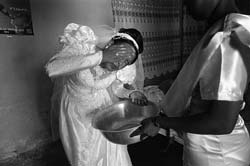
The Bride Grooms: After her wedding at St. Mary's Church, Freweine Asgedom returns to her home to freshen up. She chose her husband, a sign of changing times. |
"When the wedding day arrived, they wrapped me in cloth, covered my face, put me on a donkey with the best man, and he took me to my husband's home,'' says Tsega, remembering her wedding, a marriage arranged by her family to a man she'd never met. "At the end of the day, after the wedding vows, after the party, after everything is finished, I saw him for the first time. I was afraid, very afraid.''
But times have changed. After her vows at St. Mary's church, Freweine Asgedom, 26, returns to her home in Asmara to freshen up. As she washes her face, her relatives load her belongings into the back of a pickup. They'll transport the pile of gifts and household goods to her new home while she and her family host an afternoon lunch for the groom's family.
Her father drives her to the party. She's singing along with the music on the radio. She's smiling. She sprays me with her perfume.
"It's an honor, Cheryl,'' Ruth says.
|
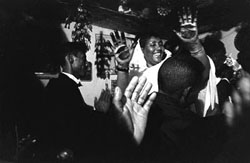
In Celebration: Friends and family dance around a newly married couple. Women traditionally use henna to paint their hands for marriage celebrations. |
|
By tradition, Eritrean women don't smile at their weddings. They cast their eyes down or away. Freweine sits quietly in a room. Her female friends and relatives gather with her in a salon as she waits for her husband to come and escort her to the party.
When Alem Abrahal comes for his new wife, he extends his hand and helps her stand up. He leans toward her and gives her the gentlest of kisses. She smiles.
« previous more »
Copyright © 2005 International Reporting Project. All Rights Reserved.