

|
|
|
|
|
|
|
|
|
|
|
|
|
|
Photo Essay: Eritrea (continued)
Saba Nagesh, 43, a single woman who adopted a daughter, marches -- quickly -- to her own beat, and rarely misses one. Smoking cigarettes, taking phone calls, signing paperwork throughout our interview, Saba is all business.
She was born in Asmara but left the country in 1971, living in Switzerland and the United States, earning a bachelor's degree in marketing from UCLA. She worked as a fashion rep in Italy and the United States before returning to Eritrea in 1998.
|
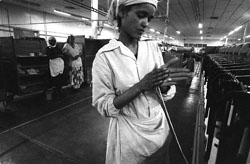
With $4 million of her own money and a loan from the government, she purchased a textile factory. A Day's Work: A woman rolls cotton in the spinning department at Barocko textile factory. Opened in 1993, the factory now employs 850 workers. |
"I saw an opportunity,'' she says. "The country is starting from zero, so you can start with the country.'' She named her company Barocko Eritrea and developed a slogan: "New fashion for a new nation.'' She had visions of manufacturing bright-colored mini-skirts and hot pants. But when war erupted again, Saba, a consummate businesswoman, saw a new opportunity.
Now her factory manufactures camouflage 24/7. She employs 850 workers, 80 percent of whom are women. Women work as electricians, mechanics, spinners, seamstresses and floor supervisors, earning on average $45 to $65 a month, depending on the worker's skills and responsibilities.
Despite the war, Saba talks of the future with optimism. She's negotiating to purchase a plantation in western Eritrea so she will have her own supply of raw cotton. But she remembers her heartsickness when she visited the front line near Tserona, shortly after the March battle.
Bodies were piled along the trenches, and the stench of rotting flesh was overpowering. She had once manufactured uniforms for the Ethiopian army. Now she made uniforms for independent Eritrea. In the carnage, she determined which bodies were Eritrean and which were Ethiopian by examining the buttons.
« previous more »
Copyright © 2005 International Reporting Project. All Rights Reserved.