

|
|
|
|
|
|
|
|
|
|
|
|
|
|
Photo Essay: The Aral Sea's Isle of Despair (Continued)

|
Sitting in his large office in Tashkent, the capital of Uzbekistan, Rim Giniatullin looks like a Soviet apparatchik, which is what he was. For more than two decades, he worked in the Uzbek Water Ministry, eventually becoming director. Many people see him as a key architect of the Aral's demise. He now runs the International Fund For Saving The Aral Sea (IFAS), Uzbekistan's entry into the alphabet soup of groups created to address the problem. Despite a fearsome reputation, he was friendly to me. He felt very strongly about the irrigation system. "I grew up in the desert," he told me. "I used to drink salty water from the well. To serve the water system, that was my dream." |
|
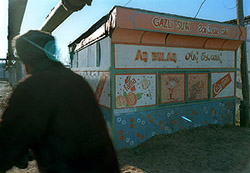
Kiosk, Nukus. The Russians left another water-related legacy: gazli suw, the extremely carbonated water that is sold everywhere. To the left are water pipes, which were built aboveground to reduce the chance of freezing. Like most of Karakalpakstan, the water in Nukus is very salty. Many researchers believe that the salt contributes to the region's health problems. Ironically, this irrigation system has not only ruined the Aral, it has also rendered the region's water much saltier. Because the canals were badly designed, excess water accumulates underground, leaching tons of salt to the surface, and into wells. (This salt has also destroyed hundreds of thousands of acres. Driving through Karakalpakstan, one sees empty fields covered by what looks like a light dusting of snow. It is salt.) |
|
|
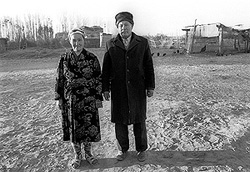
A married couple in Karakalpakstan, outside the village of Tartakupir. |
« previous more »
Copyright © 2005 International Reporting Project. All Rights Reserved.