
|
|
|
|
|
|
|
|
|
|
|
|
|
|
The Struggle Continues
Could winning equal rights on the battlefield earn Eritrean women more rights in civil society? Through her front-line photography, IRP Fellow Cheryl Hatch aimed to find out.
|
more on Cheryl Hatch
|
ERITREA -- During Eritrea's 30-year battle for independence from Ethiopia, from 1961 to 1991, Eritrean women fought next to men in the trenches and on the battlefield. Reporter and photographer Cheryl Hatch was on the scene in Africa near the end of that war, around the time the tiny nation of Eritrea won its autonomy. Given the patriarchal nature of Eritrean culture before the war (women were not allowed to own property, the vast majority were illiterate, most marriages were arranged, and genital mutilation was routine), Hatch wondered: "Could winning equal rights on the battlefield earn women the same rights in civil society?"
|
She returned to Eritrea last winter to find out, funded by a IRP Fellowship from Hopkins's Nitze School of Advanced International Studies (SAIS). The newly launched program at SAIS encourages working journalists to bring to light important international stories that have received scant attention. |
|
|
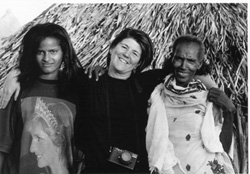
Cheryl Hatch flanked by Eritrea women |
What Hatch found in Eritrea was "a report card both good and bad," she says. After just several years of peace, war erupted again in 1998, in what has now become, she says, "the bloodiest conflict on the planet, one that both sides say they don't want, and neither side can explain." Hatch slept in refugee camps, holed up in front-line bunkers, and conducted countless interviews to capture the images you see here. Her findings: Eritrean women now have representation in government and the right to own property. And more young women are choosing the men they marry. But other things haven't changed. Some 85 percent of women remain illiterate, and 85 percent of girls, both Christian and Muslim, are still being genitally mutilated.
--Sue De Pasquale
|
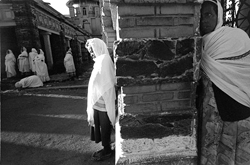
Beginning at 4 a.m. each morning, crowds of Eritrean women gather at St. Mary's Church in Asmara to pray for peace. These are the Eritrean mothers, deified in their culture, who have offered their sons and daughters to the struggle; women comprise nearly a third of the military. Some women gather inside the church; others fill the courtyard. |
|
|
|
St. Mary's Church in Asmara |
Unclean women (those who are menstruating, have recently given birth, or had sex the night before) must remain outside the gate. Women now have the right to own property and you see fewer arranged marriages; but there's been little progress in terms of genital mutilation and illiteracy.
The fighting between Ethiopia and Eritrea is pretty much the bloodiest conflict on the planet and nobody's talking about it.
|
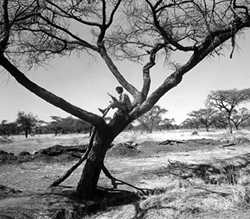
In the heat of the day, a lone fighter stands guard in an acacia tree at Egri Mikhal. Beyond the front-line trench, the Eritreans have heavily mined the stretch of land that separates them from the Ethiopian soldiers. Daily life continues in Asmara, where three young girls jump rope (below), despite the ongoing threat of war just 60 miles away from the capital city at the border with Ethiopia. |
|
|
A lone soldier guards the trenches from an acacia tree at the Ethiopian-Ertirean border |
|
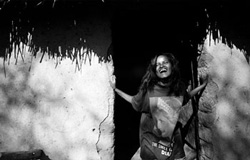
Genitally mutilated when she was a young girl, 16-year-old Gabriella Zerom now works in a government-sponsored campaign to educate others about associated health risks; circumcision is practiced upon 85 percent of women in Eritrea. |
|
|
|
Gabriella Zerom in her doorway |
|
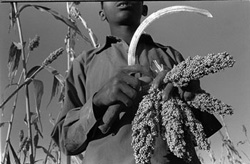
Villagers in Mai Aini raise baskets of teff over their heads and use the wind to sift the chaff. Teff is a staple food source in Eritrea, used to make njera, a large pancake bread with a slightly sour taste and doughy texture. Although Mai Aini is just miles from the front line at Tserona, the villagers continued the harvest. |
|
|
A young boy harvests teff |
|
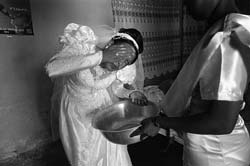
After her Sunday morning Orthodox wedding at St. Mary's church, Freweine Asgedom, 26, returns home to freshen up. She and her family will shortly host the groom's friends and family at a lavish lunch, with dancing and drinking of mes, a honey wine. |
|
|
|
Freweine Asgedom at home after her wedding ceremony |
Thousands of Eritrean women march along Independence Avenue, demonstrating their desire for peace and an end to the two-year conflict that has claimed 50,000 lives. Waking from a late afternoon nap, an Eritrean soldier plays his handmade kirar, a traditional musical instrument, in a bunker in the front-line trench at Egri Mikhal.
|
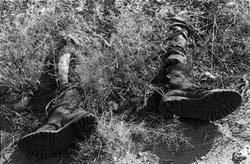
The leg bones of an Ethiopian soldier protrude from his boots along the Eritrean trenches at Egri Mikhal on the border near Tserona. |
|
|
A dead Ethiopian soldier |
Copyright © 2005 International Reporting Project. All Rights Reserved.