

|
|
|
|
|
|
|
|
|
|
|
|
|
|

Always room for kindness in China
What's crowding to one is graciousness to another
|
more on Sarah Carr
|
Jan. 26, 2007 -- When I went to China to visit and write about its schools, I expected to feel isolated.
I didn't know much of the language and mistakenly assumed the schools and people would be resistant to my visits and questions.
 |
|
|
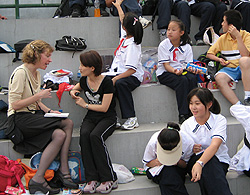
Carr conducts interviews at a public school |
I thought I would end most days alone in a hotel room with no one talk to.
In fact, I encountered the opposite situation.
Virtually every school I visited, rich or poor, took me out for at least one meal.
Families invited me to stay at their homes. Schools opened their doors, even without notice.
The Chinese, I quickly learned, have a very different conception and reality when it comes to personal space and hospitality. Many of my hosts insisted it was not only a kind gesture to treat me so graciously, but their obligation.
Everywhere, I could see some of the benefits of this feeling of obligation: Extended families were more likely to live together, and children would go to great pains to care for their parents as they aged; school kids who I learned co-habitate in dorm rooms with up to a dozen peers held hands as they walked to class.
As a person who spends much of my time reading alone, running alone, writing alone, and living alone, I'll admit I struggled to adapt.
Moreover - and I write this with mixed feelings - I am accustomed to a more detached style of journalism where I control my own time and degree of involvement.
My preferred style of reporting in a classroom is to sit in the back and take it all in.
In China, the teachers put me in the front of the class, and often asked me to give the lesson.
It took me almost the entire five-week trip to let go of some of that control and detachment. To learn how to walk into a classroom without heading immediately to a seat in the back of the room.
Eat more, please
In Ningbo, I had my first introduction not only to Chinese schools, but authentic Chinese food.
By the middle of the first week, I'd eaten Ningbo seafood at three banquets hosted by schools and was starting to feel a little queasy.
I like seafood, but the banquets featured an assortment of fish and eels unlike any I'd ever seen, as well as crabs and shrimp and other shellfish that are cooked live at the restaurant and served with the shells, bones, everything.
It was hard to leave the table without trying at least a little of each dish.
As one afternoon wound down, I decided to eat a light dinner and then head to bed in an attempt to ward off a stomach flu.
A moment later, though, my translator at the Zhongxing School said administrators would host me shortly at a dinner banquet.
This meal featured more seafood than all the rest, and many of the dishes were introduced as delicacies that had been ordered specifically for me.
Unsuccessfully, I tried to de-shell a crab gracefully and eat what was described as the foot of a goose.
After about an hour and a half, the table was still piled with food, and the translator turned to me and pleaded, "Sarah, please try to eat some more."
They seemed a little disappointed with my eating prowess, and probably doubted my claim to have grown up by the ocean. But because they were so gracious, they kept looking for areas where I could excel.
I was "very clever" to have picked up the use of chopsticks. My pronunciation of two Chinese words was decidedly "understandable." And when I had finished half a glass of wine, the translator turned to me, hopefully, and asked: "Sarah, are you a good drinker?"
A burst of frustration
In Shenzhen, the city I traveled to after Ningbo, my trip hit its only low point.
It was largely my fault.
Frustrated by the difficulties I faced finding schools to visit there, I grew anxious about all the activities I blindly perceived as extracurricular. I wanted to make sure that I made it into more schools in Beijing, my next stop.
On my last day in Shenzhen, I desperately wanted to do some laundry, line up some appointments in Beijing, read through my notes, and write. But the teachers at the training center had literally booked my day from 7 a.m. until midnight with sightseeing, visits to their classes, and meals. They had even found me another hotel right next door to their center, and taken the liberty of checking me in.
That morning:
"I really need to do laundry," I said.
"Don't worry, we can do that for you," a teacher replied.
"But I also need to send out some e-mails."
"You can use our boss' computer."
During an afternoon discussion with 20 or so parents at the center:
"How about if I just talk to one or two of them?" I asked.
"But if you talk with all of them at the same time you can hear so many more perspectives."
Throughout the day, I felt a sharp need to be alone. And I felt an unjustified burst of anger - incited by nothing more than an overwhelming kindness and concern on the part of my hosts.
These weren't government minders, but teachers who had little idea of what to do with me.
Rashly, I told them I couldn't go to the play they had planned to take me to that night.
I told them I was unhappy they had checked me into a new hotel, one so cheap that the pillowcases had blood stains on them.
The first part of that evening I spent doing exactly what I had initially thought I would be doing every night in China: Sitting in front of a computer screen, alone.
Forming a community
But about 11:30 p.m., one of the teachers asked if I would join them for a late-night dinner. Partly out of guilt, I went.
The restaurant was sweltering, and flies buzzed around us. But virtually everyone from the school was there: The ostentatious, BMW-driving husband of the director, who had dragged me out one night to hit golf balls; the English teacher from Inner Mongolia who liked to sing plaintive, beautiful songs about his hometown; the shy math tutor from the Sichuan province, who made so many toasts he quickly became beet red and drunk; the elegant couple in their 70s in charge of the center's dance department.
They stayed at the restaurant until about 2 a.m. talking about where they came from, toasting and laughing.
When everyone left, the elderly couple walked me back to my shabby hotel and I realized - with much shame - that they lived there.
None of the teachers was originally from Shenzhen, but they had formed a close-knit community there - one so welcoming they would stay at work until midnight on a Saturday night to take a rude American stranger out to dinner.
They might trip over each other and miss their hometowns, but there wasn't very much time - or space - to feel lonely.
Repeatedly, the teachers at that dinner asked me what I thought of their English classes, their center, and their country.
I realized some of what I might have perceived as excessive hospitality stemmed from a natural desire to make a good impression.
For the rest of my trip, I tried to go with the flow when the Chinese family hosting me in Shanghai insisted that I stay in their apartment during my time there. Or when I was asked to teach more than 60 students in a rural school.
It takes a village
One week, I traveled with a translator, Liu Liu, out to a remote village to visit the hometown of a student I wanted to profile.
As we made our way up the hill, a cluster of villagers stood at the entrance to the path that passed by their homes.
We explained that we were friends of a teenage girl who grew up there and wanted to visit with any of her relatives.
For several minutes, the villagers questioned us, denying any knowledge of the girl.
Finally, they told Liu they were worried about us cheating any of the villagers, and also wondered if we worked for the government.
It dawned on me that to get to know the family, I had to get to know the village first.
After 15 more minutes, they still would not let us pass.
In Milwaukee, I probably would have turned back and found a different way of contacting the family. But Liu and I thought the villagers were enjoying the banter, and that somehow this was all a part of the process.
We decided to pretend to give up and walk away, to see how they responded.
As we turned our backs, the villagers laughed and cried out that we could come inside.
I took some comfort in returning to my own apartment and my own fly-on-the-wall reporting style. And I don't miss having to pack up my bags and move into a new hotel every few days. But I do miss being at a school where everyone would stay until midnight to take a stranger out to dinner. I miss trying to visit a family, and having the whole town check me out first. (I can only imagine what would have happened if I had tried to date in China.) I miss the sense of national pride and identity that many Chinese people said leads them to want to make a good impression.
Most of all, I miss spending time with so many people who care very deeply what the rest of the world thinks of them.
Copyright © 2007 International Reporting Project. All Rights Reserved.