

|
|
|
|
|
|
|
|
|
|
|
|
|
|

Free Media and More Transparent Government Can Help Limit Corruption, Scholar Says
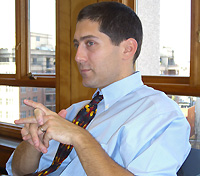
WASHINGTON, February 9, 2006 � Measuring corruption in countries is difficult, but some measures for tackling corruption can be surprisingly simple, said Todd Moss, research fellow and Africa expert at the Center for Global Development. In a wide-ranging talk to the IRP Fellows and SAIS community, Moss discussed the difficulties of measuring and tackling corrupt practices.
 |
|
| Todd Moss |
He began by looking at one of the most widely cited corruption indices, Transparency International’s Corruption Perception Index. He pointed out that the rankings are based upon perceptions of corruption, rather than documented instances of corruption. “Corruption is a visceral, emotional issue,” Moss explained. “You’ll always remember paying a bribe.” Because of this, the perception that a country is corrupt can linger long after a country has actually made progress cleaning up crooked practices. Other indices that attempt to measure corruption include World Bank indices that measure good governance and anti-corruption efforts, and the International Country Risk Guide.
Moss discussed the debilitating effects that corruption can have on a country and its citizens. He argued that corruption denies services to the public, harms a country’s future by reducing the prospects of investment and other economic opportunities, increases poverty and undermines state legitimacy. In extreme cases, corrupt states can deteriorate into kleptocracies that exist almost solely to steal money.
The media have a crucial role to play when it comes to discovering corruption, Moss said. Citing several cases in his region of expertise, he said investigative reporters have been instrumental in discovering corruption scandals in Kenya, Zimbabwe, Ghana and elsewhere. “It is usually the media who uncovers this stuff.”
Attention-getting corruption scandals, such as in Uganda and Kenya, are actually good developments, Moss argued. They indicate that attention is being paid to the issue and something is being done about it. More worrisome, he said, are countries that are notoriously corrupt but have never had a large scandal, such as the Central African Republic.
Conquering corruption in developing countries can occasionally be very simple, Moss said. In Uganda, for example, some schools in rural areas were losing out on 80% of the funding allocated to them because of corruption. Rather than pursuing a complicated “cat-and-mouse game” to track down the money, authorities sent the headmaster of each school in the selected districts a sheet of paper detailing the money the school should receive. Headmasters posted the paper on the school’s door for the entire community to see. Once communities knew how much money they should be getting, almost all of the school funds arrived.
Increasing government transparency is also an effective way to tackle corruption. Publishing budgets is still an innovation in some countries, Moss said. Angola still doesn’t publish its budget and punishes companies that publicize the terms of government contracts, Moss said. For example, when British Petroleum (BP), under pressure from the British government, published the amount of money it paid to Angola for oil contracts, it promptly lost those contracts.
Although corruption is primarily a local issue, Moss said, foreign aid donors are not blameless. In 22 countries in Africa, half of the budget comes from foreign aid. Donors are obviously aware of the problems of corruption, he said, but some organizations have been slow to deal with it. The World Bank only began addressing corruption when James Wolfensohn became president of the Bank in 1995. Until 1996, according to Moss, European countries could write off bribes when filing their taxes.
Corruption is often treated as a moral issue, Moss said, but in his opinion corruption goes far beyond morality. “There is much more to corruption than people’s personal honesty,” he said. “I refuse to believe that people in one country are more moral than people of another country.” Instead, he argued, systemic factors, such as bad policies, poor governance, low salaries, or lack of other means to wealth, can create the conditions for corrupt practices.
Copyright © 2005 International Reporting Project. All Rights Reserved.