

|
|
|
|
|
|
|
|
|
|
|
|
|
|

IRP Fellows and SAIS Masters in Public Policy Students Discuss Changes in the News Media
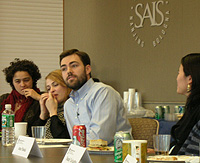
WASHINGTON, January 27, 2006 � Changes in the media were the topic of discussion among the spring 2006 International Reporting Project Fellows and the mid-career SAIS Masters In Public Policy (MIPP) students at a forum that has become a bi-annual tradition at SAIS.
 |
|
| Spring 2006 Fellow Barry Simmons |
International Reporting Project Fellows are working journalists who come to SAIS on a 13 week fellowship to study international topics, and then travel overseas for international reporting. The SAIS MIPP students are a diverse mix of mid-career professionals from around the world who have worked for at least nine years prior to coming to SAIS. Many of them work in banking, consulting, with non-profits, and in the military. Some are also journalists.
MIPP students spoke about the difficulty of finding in-depth international stories, and the need to browse many news sources—often on the Internet —to get the information they need. “Is anyone catering to me?” asked MIPP student Jenifer Rogers. IRP Fellows asked MIPP students how they consumed news, and several of them emphasized the need to multitask, saying they listed to radio stations such as NPR while getting ready for work in the morning. Gene Moses, a recently graduated MIPP student, said he now prefers the subscription-only TimesSelect service provided online by The New York Times, and downloads a condensed synopsis of each day’s top news stories every morning onto his iPod.
MIPP students asked the IRP Fellows what affects the quality of their work today. IRP Fellows expressed frustration with shrinking newsroom budgets and staff cutbacks, and with the difficulty of funding news content on the web, much of which can be read for free. They have had to increase the quantity of stories they produce, which sometimes limits the quality of their work. IRP television fellow Barry Simmons of WTVF-TV in Nashville said some stations, in an effort to cut costs, are now experimenting with making a reporter his or her own cameraman, equipping the reporter with smaller equipment and a laptop computer. He added that television reporters now spend a greater amount of time talking live on air, leaving little time to investigate more complex stories.
Several IRP Fellows say they continue to work on longer features despite time constraints. Phuong Ly, an immigration reporter for The Washington Post, takes weeks or months to write stories on immigrant communities in the Washington area. She puts in more time on the weekends than she did covering daily news in order to achieve the quality she aims for.
IRP fellows also sought feedback from several military officers among the MIPP students. Joaquin Malavet, a U.S. Army officer who has served overseas on both combat and humanitarian missions, said that he reads daily morning news as part of his job and that over time he has appreciated the range of coverage. “You need to show the good, the bad and the ugly, and let people decide,” he said, commending the media for portraying many sides of the Iraq conflict. But he also expressed a desire to see more diverse coverage of non-traditional topics, such as the role of women in developing countries and conflict zones, who he says are “more important than ever around the world today.” Another officer added that military personnel are often frustrated that positive developments in Iraq don’t make the news, but said he has seen “a lot of integrity” in the news coverage, including in admitting mistakes.
Copyright © 2005 International Reporting Project. All Rights Reserved.