

|
|
|
|
|
|
|
|
|
|
|
|
|
|

World Bank Seeks to �Green� Its Development Projects
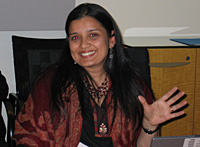
WASHINGTON, January 27, 2005 � The World Bank has quintupled its investment in the environment over the past decade and is now pouring $10.7 billion in projects that focus on biodiversity and climate change, as well as land, air and water quality preservation in the 100-plus countries where it operates, World Bank environmental health specialist Anjali Acharya told IRP fellows.
 |
|
| Anjali Acharya |
�We�re trying to green our operation,� Acharya told IRP fellows who visited the World Bank Headquarters on Jan. 27. �Every single bank project that goes to the board for approval,� she added, �is first pre-screened to make sure we�re aware of [their] environmental consequences and that appropriate mitigation plans are in place.�
The investment amounts to 12 percent of the bank�s portfolio � a sum that funds the conservation work that World Bank has required on every project since 2001, Achraya said. The requirement is, in essence, an acknowledgement that the bank cannot fulfill its mission of reducing poverty and improving lives if it does not promote the marriage between development and environmental conservation, she said.
The World Health Organization estimates that air and water pollution are responsible for 20 percent of the diseases that afflict people in developing countries. According to a World Bank study, some countries spend 4 to 8 percent of their gross domestic product to deal with the effects of environmental degradation.
Three million people die annually from water-borne diseases and another two million die as a result of indoor air pollution caused primarily by defective stoves and poor heating fuel systems, Acharya said.
Acharya, who has worked for the World Bank for nine years, said one of her team�s primary goals is to educate World Bank engineers so that they are aware that the bridges, dams and power plants they build can also play a role in improving the health and increase the life span of the people they benefit.
�The ultimate thing we�re trying to reach is [understand] the impact that we�re having on people,� Acharya said. �We can say we increased [water] tap connections by 10,000. Good, that�s one indicator. But � how much are we improving quality of life? How much disease are we reducing? These are the kinds of indicators that we�re trying to develop so that we�re truly aware of the impact our projects are having.�
Copyright © 2005 International Reporting Project. All Rights Reserved.