

|
|
|
|
|
|
|
|
|
|
|
|
|
|

Deep Divisions Among Sunnis, Shiites and Kurds Will Challenge Stability of New Iraqi Government, says IRP Journalist-in-Residence
WASHINGTON, February 9, 2005 � Even though the recent elections in Iraq went off much better than anticipated, it is �too early to call the election a success,� Rajiv Chandrasekaran, former Washington Post Baghdad bureau chief told a group of International Reporting Project (IRP) Fellows and others here today.
 |
|
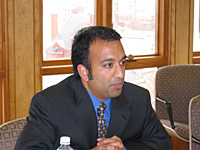
| Rajiv Chandrasekaran |
Chandrasekaran, the IRP Journalist-in-Residence, is writing a book about Iraq based on his more than 18 months reporting from Baghdad. His talk focused on the January 30th elections in Iraq. Despite the threats and in defiance of suicide bombs, Iraqi citizens voted for the first time in half a century.
�There is no doubt that the 30th was a good day,� he said, �but the real proof will be seen first in the election results, and then in the government that comes from it as a result of the back room negotiations.�
Chandrasekaran pointed out that the turnout was low, with only 54 percent of the eligible population voting, and large segments of society � namely the Sunnis � not even showing up at the polls. With so little support coming from the general population, it will be up to the new government to prove that it can both represent the interests of its people as well as answer the needs of an increasingly divided country.
Chandrasekaran said even the most seasoned cynic found it hard to remain unmoved by the sight of Iraqis lining up at the polls last month. They waved ink stained fingers at the television cameras, proof that they had participated in an experiment in Middle Eastern democracy that, if successful, could have region-wide repercussions.
Each of the three major interest groups in Iraq emerged from the elections with a distinct set of demands and expectations. The majority Shiites, said Chandrasekaran, want what they feel is �rightfully theirs -- to run the country.� They, in turn, are split between parties who favor an Islamic government, and those who want a secular democracy.
Chandrasekaran said the Kurds in Iraq have three basic demands: that Shari�a or Islamic law not be applied to them; an autonomous Kurdish region that includes the oil-rich region of Kirkuk, and to retain their peshmerga militia intact as a fighting force.
Chandrasekaran said the Sunnis, who include a range from nationalist, secular leaders to religious figures, want a seat at the table, and a timetable for withdrawal of US forces and the release of prisoners, who are overwhelmingly Sunni Arabs. "Even though the vast majority of the Sunnis didn't go to the polls, do not assume that they are indifferent," said Chandrasekaran. He described the rejectionists as a persuasive, but fairly small group.
If Sunni leaders are given prominent positions in the government, he said, a large percentage of regular Sunnis might be willing to give the new government a chance. "It could be a major turning point." One problem, however, is that few Sunni Arab leaders enjoy broad support among the majority of the Sunni population.
Forming a government is only the first step, Chandrasekaran said. Once in place the new President, two Vice Presidents and the Prime Minister will have to preside over the drawing up of a working constitution that juggles the wildly divergent desires of Iraq's different groups. Only then can last month's elections be truly called a success, he noted.
Copyright © 2005 International Reporting Project. All Rights Reserved.