

|
|
|
|
|
|
|
|
|
|
|
|
|
|

Training in Conflict Resolution Becomes New Tool for Solving Africa�s Disputes
Washington, January 26, 2005 � "Give us money!" chanted the Tutsi general and the Hutu nun, marching down the hotel corridor in Ngozi, Burundi.
 |
|
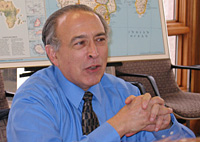
| Howard Wolpe |
Former Michigan congressman Howard Wolpe has been negotiating conflicts in Africa for years, but even he was surprised when the towering general and the diminutive nun, long on opposing sides of that country�s bitter ethnic differences, marched together. It was the third day of conflict resolution training exercises that Wolpe believes could be a model for reducing ethnic or religious hostilities in war-torn nations.
In a talk to the 2005 IRP Fellows, Wolpe, who currently directs the Africa Program at the Woodrow Wilson International Center for Scholars in Washington, DC. said the Burundi Leadership Training Program (BLTP) may be a model for other post-conflict nations such as Rwanda, the Congo, and even Iraq. �It�s a very powerful set of tools we�re using,� said Wolpe.
Wolpe said he believes deeply divided factions in fragile African democracies may be able to bridge chasms of distrust and rebuild shattered nations through improved communication and negotiation skills. His goal is to move rival groups away from a zero-sum mentality, where one group sees its survival coming at the expense of another �to a recognition that their own self-interest can be strengthened rather than weakened by cooperation with others.�
The problem with many peace accords in Africa, Wolpe believes, is that the agreements are often imposed from the outside, and the parties in the conflict have not bought into the solutions. He is trying to change that by transforming attitudes. He believes he has a winning formula.
Wolpe, a former Presidential Special Envoy to Africa�s Great Lakes region, and colleague Steven McDonald set to work on the pilot project � funded by the World Bank and the U.S. Agency for International Development � in November 2003. They went through a laborious process to find participants that reflected the ongoing tensions in Burundian society. Like neighboring Rwanda, Burundi has had a history of conflict between ethnic Tutsis and Hutus which has led to widespread bloodshed.
Wolpe said he and McDonald assembled training groups that reflected the composition of Burundian society: half Hutu and half Tutsi, and a few representatives of the minority Twa. Within these, they included representatives from the army, rebel groups, and religious and civil society groups. Wolpe noted that vetting BLTP participants through peer-review was crucial in finding Burundians who would have the stature to be influential in jump-starting post-conflict dialogue and moves towards reconciliation.
To date, Wolpe said, three groups have been trained through a variety of role-playing and practical communication exercises that aim to hone participants� listening and negotiation skills. The exercises impart the sense that collaboration works better than competition. Wolpe says the BLTP has been a remarkable success so far, adding that the World Bank and the U.S. State Department have expressed interest in starting similar trainings in Rwanda and Congo in an effort to lessen ethnic tensions there and promote greater security.
Copyright © 2005 International Reporting Project. All Rights Reserved.