

|
|
|
|
|
|
|
|
|
|
|
|
|
|

Putin Flexes Russia�s Muscle in Former Soviet Republics, Says Russia Expert
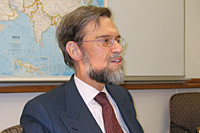
WASHINGTON, February 1, 2005 � Recent moves by President Vladimir Putin have signaled a tougher stance by Russia towards its neighbors, according to Charles H. Fairbanks, Jr., a Russia foreign policy expert and former deputy assistant secretary of the U.S. State Department.
 |
|
| Charles Fairbanks |
In a seminar with IRP fellows today, Fairbanks noted interference in Ukraine�s recent elections as the latest incident of Russia flexing its muscle in the former Soviet republics known as the �near abroad.� �One senses that events have made Putin respond less reasonably and more emotionally,� Fairbanks said.
In December 2004 Russia withdrew from a border-monitoring mission sponsored by the Organization for Security and Cooperation in Europe (OSCE) � another decision, said Fairbanks, that indicates the country�s departure from �a process of rationally creating a sphere of influence.� OSCE border patrols monitored Chechen fighters passing between Georgia and Chechnya. Russia�s objection to extend OSCE�s mission was the country�s latest attack against the regional security agency, which Russia has also criticized for its election monitoring efforts in Belarus, Ukraine, and Uzbekistan.
Fairbanks, director of the The Johns Hopkins University School of Advanced International Studies� Central Asia-Caucasus Institute, says the posture change marks a new phase in Russia�s foreign policy. �Because Russia is diplomatically and militarily weak, it is much easier for Russia to cause trouble and undermine [near abroad] states than it is to establish strong relationships,� he said.
Other recent examples of Russia�s greater exertion of control over its former republics include its Kozak plan, Moscow�s answer to the conflict between Moldova and the break away region of Transdniester. The plan, which Moldova President Vladimir Voronin rejected, required that Moldova surrender sovereignty to Moscow.
Fairbanks acknowledged exceptions to what he characterized as Russia�s latest destabilizing role in the region, noting, for instance, Putin�s attempts to mend relations with Azerbaijan in the oil-rich Caspian Sea. Fairbanks also credited Putin for increasing economic cooperation and development with the Commonwealth of Independent States.
Copyright © 2005 International Reporting Project. All Rights Reserved.