

|
|
|
|
|
|
|
|
|
|
|
|
|
|

Psychiatric Services Needed for Impoverished Countries
Washington, February 11, 2004 -- For the second time in as many weeks, members of the Spring 2004 IRP Fellowship Program found themselves on their knees. The first time, they were responding to a mock hostage attack staged by Centurion Risk Assessment. This time around, the Fellows were acting as amateur anthropologists in an imaginary matriarchal society, as Dennis Hunt of the Center for Multicultural Human Services led them through an exercise to increase awareness of the cultural biases that can interfere with effective diagnosis and treatment of mental illness in other cultures.
 |
|
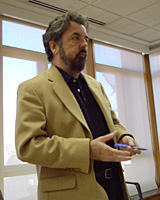
| Dennis
Hunt |
Psychiatric disorders afflict people in all countries and cultures and account for five of the 10 leading causes of disability and premature death worldwide. Nevertheless, mental illness takes a back seat in health-policy planning in most countries, and gets short shrift in media coverage as well. And yet, as Hunt noted in his talk, the issues that do grab the headlines - from violent conflict to disease epidemics - inevitably leave a swath of emotional problems in their wake.
Hunt, a clinical psychologist who has worked extensively on cross-cultural mental health issues, spoke movingly about such problems. Children who grow up surrounded by poverty, violence, and hopelessness "will stare at you blankly when you ask them what they want to be when they grow up," he said. "The fact is they may not grow up, and they know it."
The Center for Multicultural Human Services works to provide culturally appropriate therapeutic services and raise the profile of mental health issues in the international arena, but Hunt, who founded and directs the center, said it is an uphill battle. The U.S. boasts 16 psychiatrists per 100,000 citizens; by contrast, African nations (with the exception of South Africa) have an average of one psychiatrist per one million citizens.
Countries without trained mental-health care practitioners rely on alternative or informal providers, such as family members, community elders, and religious leaders. Such figures can provide important support and may be as effective as talk therapy or Prozac, Hunt said. But when traditional social orders collapse due to disease or violence, when trust breaks down and community infrastructures are destroyed, the prospects for help are slim.
That, said Hunt, is when both micro- and macro-level solutions are needed: help for individuals as well as healing for society at large. For example, he noted, in countries torn apart by violence, truth and reconciliation processes are as valuable as any therapy: "To see perpetrators come to justice goes very far in reestablishing a sense that there is some hope, that in the end, good does win out."
Copyright © 2005 International Reporting Project. All Rights Reserved.