

|
|
|
|
|
|
|
|
|
|
|
|
|
|

US Intelligence Needs More Human Sources and More Risk Taking to Defeat Terrorists, says Intelligence Expert
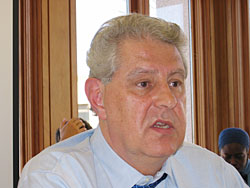
WASHINGTON, September 20, 2004 � The recent failings in U.S. intelligence gathering on al-Qaeda and Iraq have stemmed from a lack of human intelligence sources, a culture of misinformation and flawed tactics, former Central Intelligence Agency chief of counterterrorism operations Vincent Cannistraro told a gathering of International Reporting Project Fellows and other SAIS community members.
 |
|
| Vincent Cannistraro |
In Iraq, he believes U.S. officials became overly dependent on electronic intercepts. Iraqi Baathist officials, trained by the old Soviet KGB at deception, knew the frequency of U.S. satellites and could detect when their conversations were being picked up. Management problems also played a role. US-backed Iraqi opposition groups and the Pentagon�s Office of Special Plans promoted flawed information, but intelligence analysts� doubts about the information were not communicated to senior policymakers because effective dissent channels were not in place. The end result, he said, was to cycle misinformation, disinformation, and fraudulent data to key policy makers at the White House and to ignore conflicting data.
He traced the failure to stop al-Qaeda to the CIA�s longtime focus on �secular terrorists� rather than �religious fanatics.� Usama bin Laden appeared on the U.S. radar screen around 1992, he said, after the first Persian Gulf War. But the threat he represented to American interests did not become clear until 1998 when he admitted a part in the 1993 downing of U.S. Army Black Hawk helicopters in Somalia. �The U.S. didn�t understand that, did not understand that he played a role, that he represented a danger, that he was anything more than a religious crank in Saudi Arabia railing against the Saudi monarchy for its hosting of Western troops in Saudi Arabia.�
Compounding that oversight was a mentality in Congress that regarded foreign agents who had committed human rights abuses as unacceptable. He said the government was too quick to take them off its payrolls, limiting its access to terrorists. �It�s that kind of political correctness that you can�t afford in the intelligence business.�
The US also underestimated its ability to recruit radical Islamists, and suffered from a lack of human intelligence sources. He cited the young American convicted of aiding the Taliban government. �If John Walker Lindh could penetrate that organization, it seems to me the U.S. government could do it using a little bit of creativity and imagination. We didn�t do it.�
Finally, the discovery of American spies Aldrich Ames and Robert Hanssen, who passed valuable information to the Russians, also dealt devastating blows to the US intelligence community. �Security became an obsession rather than a need and a requirement � and that meant more and more people were removed from the rolls.�
Cannistraro believes the intelligence community needs a National Director of Intelligence who has budgetary authority and sufficient rank to advise the president on intelligence - and a CIA director who is only responsible for the CIA. �The CIA director should not be responsible for the entire intelligence community,� he said.
Copyright © 2005 International Reporting Project. All Rights Reserved.