

|
|
|
|
|
|
|
|
|
|
|
|
|
|

US Must Increase Aid to Afghanistan or Risk Chaos, Says SAIS South Asia Expert
Washington, September 17, 2003- If the US wishes to secure a lasting peace in Afghanistan, it needs to ensure that country has more money, troops, and international support, said Walter Andersen, associate director of South Asian Studies at Johns Hopkins University's School of Advanced International Studies. He delivered his remarks to a group of journalists that included fellows from the International Reporting Project and the Minnesota-based World Press Institute.
 |
|
|
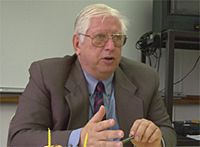
Walter Andersen tells IRP Fellows about challenges faced by the U.S. in Asia. |
He warned that the U.S. government must consider the balance of power between Afghanistan's various ethnic groups, which include Pashtuns, Tajiks, Hazaras, and Uzbeks. The predominantly Pashtun Taliban, whom the US helped overthrow after the September 11, 2001 attacks, are attempting to retake parts of the country with aid from ethnic allies in Pakistan. He said Pashtuns feel underrepresented in the current Afghan government.
Andersen said the last time the U.S. was engaged in Afghanistan supporting mujahedeen fighters against the Soviet Union, it abandoned the country abruptly after the communist defeat in 1989. "The American government incorrectly determined that somehow all these groups would get together and form a stable government," he said. "That did not happen."
Andersen, who until July 2003 was the South Asia division chief in the State Department's Bureau of Intelligence and Research, considers South Asia to be "one of the most violent places in the world." He attributed the region's volatility to the failure of governments there to accommodate ethnic minorities. Ethnic divisions splinter nearly every country in the region-from Afghanistan to Burma.
Andersen noted the US' uneasy alliance with Pakistan, which is home to several militant organizations that use terrorist tactics to fight against Indian rule in Kashmir. Washington considers Pakistan a key ally in its anti-terror campaign.
He said that groups like the Pakistan-based Lashkar-e-Toiba and Jaish-e-Muhammad, both of which are on the U.S. list of terrorist organizations and have been banned officially by Islamabad, have undermined the Kashmiri fight for self-determination by targeting civilians. "Not all freedom struggles engage in terrorism," Andersen said. "The problem with those that do is that often the terrorist tactic becomes the predominant tactic." Citing the dispute over Kashmir's sovereignty, he said that the international community now views it as "an issue of terrorism, even though there are many groups that do not engage in terrorism in Kashmir."
Andersen said political considerations also complicate the identification of certain states as sponsors of terrorism. "In the real world, particularly in democratic countries, politics always play a role," said Andersen. "Does that mean we have to be ambiguous if not sometimes hypocritical? Yes. That's the real world."
Copyright © 2005 International Reporting Project. All Rights Reserved.