

|
|
|
|
|
|
|
|
|
|
|
|
|
|

Adapting Traditional Values is Key to Africa's Modernization, Scholar Says
 |
|
|
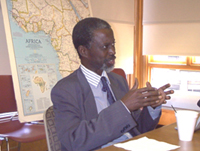
"Some of the people in some of these African societies have this idea that you have to be all on the same spot. It's a very dangerous concept," Sulayman Nyang, Professor of African Studies at Howard University told IRP Fellows. |
|
|
Click here for audio excerpt |
by Matthew Algeo, Fall 2002 IRP Fellow
WASHINGTON, September 9, 2002 - As Africa rapidly modernizes, many Africans are changing the way they look at themselves, an expert on the continent told IRP Fellows today. Sulayman Nyang, a professor of African Studies at Howard University and a former Gambian diplomat, said many Africans are "rearranging their mental furniture" and reexamining their cultural identity as they adapt to the co-existence of traditional belief systems and Western political and economic forces.
Nyang also told the Fellows that many of Africa's modern problems are complicated by longstanding belief systems. For example, he cited the current crisis in Zimbabwe, where President Robert Mugabe is attempting to seize land from white farmers and redistribute it to poor blacks
Nyang - an outspoken critic of Mugabe - said the crisis is partly the product of Zimbabweans' traditional attachment to the land - an attachment that Nyang says Mugabe is exploiting for political purposes. "There is a metaphysical and cosmological dimension to the issue," Nyang said. "You have people that have ancestors buried in some of these lands� and some of them are still nostalgic and very much attached to the land."
Nyang also said traditional belief systems make it more difficult to solve the problem of poverty in Africa. "Some of the people in some of these African societies have this idea that you have to be all on the same spot. It's a very dangerous concept," Nyang said. "That is very different from the American understanding that you can move from rags to riches."
Regarding Christian-Muslim relations in Africa, Nyang said the situation in some countries is much more combustible than in others. For example, he said, the long and bitter conflict in Sudan is fueled by fundamentalists on both sides of the religious divide, while in Senegal, Christians and Muslims have co-existed in relative peace for decades.
Nyang has written extensively on Islamic and African affairs. His works include Islam, Christianity and African Identity and A Line in the Sand: Saudi Arabia's Role in the Gulf War, co-authored with Evan Heindricks. Nyang's articles have appeared in scholarly journals in Africa, North America, Europe and Asia.
Copyright © 2005 International Reporting Project. All Rights Reserved.