

|
|
|
|
|
|
|
|
|
|
|
|
|
|

Change in the Air at Pentagon: Renovation and Reorganization at Defense Department
 |
|
|
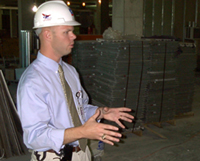
Brett Eaton talks to IRP Fellows about the Project Phoenix. |
ARLINGTON, VA - Workers are almost finished renovating the damaged corridors of the Pentagon, but officials are still struggling to modernize and streamline the way the U.S. defense department organizes itself.
Construction crews are 28 days ahead of schedule in Project Phoenix, the renovation of two million square feet of office space destroyed in the terrorist attack on Sept. 11, 2001. The first tenants moved back into the fourth floor of the northeastern side of the building on Aug. 15 - less than a year after 125 Pentagon workers died and 100 were injured in a suicide-bombing mission.
Repaired offices and hallways boast more natural light and better wiring for Internet access than the rest of the 60-year-old building, which was meant as temporary solution to the War Department's World War II space crunch.
Security has also been improved. Reconstructed offices have photo-luminescent lighting on floorboards to guide occupants in case of future attacks. Attached to each door is a removable, glow-in-the-dark map for emergency evacuations. Emergency exit buttons were moved lower so that people could push them from the ground in case they had to crawl out.
"The modernization will keep the Pentagon up to date and secure for the next 50 years," renovation spokesman Brett Eaton said Thursday during a half-day Pentagon tour for IRP Fellows.
But as a half-day tour and conversations with senior Pentagon officials showed, overhauling the Defense Department's Byzantine hierarchy and communications strategy has been more challenging than installation of safety gates and smoke detectors. Military personnel and political appointees say they're feeling resistance in attempts to change the Pentagon's command chain and update Cold War processes to the war on terror.
One of the most significant structural shifts is happening in Special Operations Forces, a 46,000-person command consisting of an elite corps of fighters who precede large-scale troop deployment on battlefields. SOF has traditionally focused on foreign missions, but Pentagon leaders want it to concentrate on homeland security too.
SOF sent the first soldiers on the ground in Afghanistan Oct. 7, 2001, and 14 men focused on building the Northern Alliance and pushing out the ruling Taliban. SOF helped install Hamid Karzai as Afghanistan's temporary president, and soldiers have guarded him during car bombings and other terrorist attacks.
SOF has nine divisions, and most are attached to geographic regions, including U.S. Pacific Command in Asia, U.S. Southern Command in Latin America, and U.S. Central Command in Central Asia and the Middle East. In response to the terrorist attacks on the Pentagon and World Trade Center, officials are attempting to blend two units into a new division responsible for homeland security.
Under the new plan, U.S. Joint Armed Forces Command and U.S. Space Command will become the U.S. Northern Command, along with personnel and responsibilities from other divisions. Officials say they have no timeline for completion, but a Navy captain likened the reorganization to the turning of an aircraft carrier.
"The whole structure as we have it now evolved slowly over 40 years, and it's hard to change it," Navy Special Forces Captain Bob Schoultz said. "This is a huge step, and it's going to require major structural changes."
Officials are also trying to reshape the perception of the Pentagon abroad. The communication division is granting more interviews with foreign journalists, including reporters at al-Jazeera, the Arabic-language satellite news station in Doha, Qatar.
"We don't do a good enough job overseas," said Tori Clarke, assistant secretary of defense for public affairs. "We're still organized the way we were in the 1970s, so we're trying to reorganize." The 80-member communication team is trying to increase its reliance on the Internet.
Clarke, who was appointed to the position 18 months ago, encourages Pentagon officials to conduct interviews with Arab journalists and says she is including more foreign journalists on media tours. But even those relatively small gestures have sparked controversy.
When Clarke arranged a media tour of Afghanistan recently, she included reporters from the Associated Press and major American newspapers, as well as London-based financial news service Reuters and Paris-based news service Agence France-Presse (AFP).
"I literally had the head of one American newspaper chain accuse me of treason for including Reuters and AFP," Clarke said.
Copyright © 2005 International Reporting Project. All Rights Reserved.