

|
|
|
|
|
|
|
|
|
|
|
|
|
|

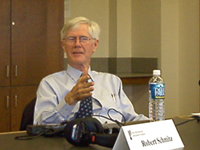
Schell: China Faces Identity Crisis and Internal Contradictions
 |
|
|
China's financial markets are a "giant casino," says Orville Schell, dean of the Graduate School of Journalism at the University of California at Berkeley. |
|
|
Click here for audio excerpt |
by Robert Schmitz, Fall 2002 IRP Fellow
Washington, September 11 - For China to reach its potential it must come to grips with its turbulent past, China scholar Orville Schell told IRP Fellows today. Schell, the dean of the University of California-Berkeley's Graduate School of Journalism and author of more than 14 books about China, said the Chinese government "does not know where it's going�it is caught in this strange situation where the model of what it should be is anchored in a world that is past, obsolete, finished, failed, and no use to anybody anymore."
Schell's observations come as the Chinese Communist Party prepares for its 16th National Congress in November, when national delegates will elect new leadership and discuss policy that will shape the next five years. Schell said predicting China's future is a lesson in paradox. "I can't think of any other country of consequence that is so replete with deep and unresolved contractions," Schell said, "it suggests a country that is deeply off-balance."
China's unstable economy is a prime example, Schell said. An astounding rate of growth, an inexhaustible supply of inexpensive labor, and one of the best savings rates in the world make China a strong capitalist market within a socialist system, a concoction Schell calls "the antichrist of capitalism." However, China's financial markets represent "basically a giant casino," with heavy government manipulation and little to no regulation, Schell said.
In addition, Schell said, China's recent entrance into the World Trade Organization will bring new pressure to perform in a global market at a time when its domestic markets are rife with corruption and uncertainty. "If you think Arthur Andersen was a poor accountant, you should see some of the balance sheets of these Chinese companies," said Schell.
Schell said that while the Chinese government tries to cope with chaotic financial markets, party corruption, and an ever-increasing gap between the country's rich and poor, the Chinese people are left behind, preoccupied with a search for themselves. According to Schell, the strict Confucian moral code of old China provided the Chinese with a sense of who they were. "Now its not clear," said Schell. "It means (now) there's a great murkiness both in terms of value systems, of morality, of human relations�and into that vacuum is rushed some of the more crude aspects of human interaction, namely, greed, avarice, self-aggrandizement."
However, Schell pointed out, the Chinese government has astounded the world in the past by succeeding when the situation looked difficult. Schell gave a firsthand account of the 1989 Tiananmen Square democracy movement to illustrate. "I said to myself 'they're never going to get this genie back in the bottle," said Schell, "I was wrong." Following that crackdown on political dissidents, Beijing has managed to continue to suppress political dissent, even while encouraging economic reforms and fostering a sustained period of economic growth.
Copyright © 2005 International Reporting Project. All Rights Reserved.