

|
|
|
|
|
|
|
|
|
|
|
|
|
|

Israeli and Palestinian Publics May Be Ready to Resume Negotiations, Former US Envoy Says
By Rachel Konrad, Fall 2002 IRP Fellow
WASHINGTON, October 2, 2002 - There are indications that Israelis and Palestinians, weary from their brutal two-year conflict, may be willing to return to the negotiating table, a former U.S. ambassador to Israel said today.
 |
|
|
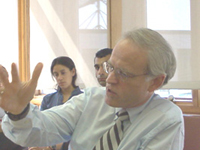
Martin Indyk discusses the Israeli/Palestinian conflict with IRP Fellows. |
"After two years of bloody conflict between Israelis and Palestinians, there is a turning point being reached in this intifada," said Martin S. Indyk, who served as US ambassador to Israel from 1995-97 and 2000-01 and is currently director of the Saban Center for Middle East Policy at the Washington-based Brookings Institution.
"With more than 1,500 [Palestinians] dead now, many more thousands wounded and with the Israeli army occupying all of the West Bank� there is an exhaustion factor that is beginning to impact on Palestinian calculations," Indyk said at a IRP Fellows seminar at the Johns Hopkins University School of Advanced International Studies (SAIS). "The people themselves are exhausted, and that is beginning to fuel a reassessment."
Israelis are also looking for a political solution to the conflict, Indyk said. He noted that Israeli Prime Minister Ariel Sharon has hinted to reporters that Israeli officials have conducted secret talks with members of the Palestinian Authority. Indyk also pointed to recent polls showing that roughly two-thirds of Israelis support the idea of an independent Palestine.
"The Israelis, too, are exhausted by this conflict, which has cost them at least 650 lives," said Indyk, who also served in President Clinton's National Security Council. "Even though there still is strong public support for a use of force to suppress terrorism and violence, there is equally strong support�for a political solution that would require Israel to evacuate many of the settlements and withdraw from much of the West Bank and accept a democratic Palestinian state along side Israel."
Despite such grass-roots support for an end of occupation, Indyk was pessimistic that the region's current leaders will come to an acceptable compromise anytime soon. "Amazingly, there is a broad consensus that the solution should be a two-state solution in which a democratic Palestine lives side-by-side with a secure Israel." Quoting Israeli foreign minister Shimon Peres, he said, "We have a light at the end of the tunnel. We just don't have a tunnel yet."
Lack of decisive leadership in Israel, within the Palestinian Authority and from the United States has stalled or thwarted attempts toward peace, he said, predicting that peace will remain elusive as long as the current leaders of these three main players remain in power.
Palestinian leader Yasser Arafat is little more than the symbolic leader of Palestine and enjoys sparse support among young Arabs, who view him as ineffectual, Indyk believes. Even Arafat's symbolic might has waned in recent months as Israel continues its third siege of his Ramallah compound, leaving Arafat stuck in a six-room bunker.
Sharon, facing an election next year against right-wing leader and former Prime Minister Benjamin Netanyahu, is taking a hard-line stance against the Palestinian leader to shore up votes among potential Netanyahu supporters. It's unclear whether Sharon will moderate his approach after his Likud party's primaries.
President Bush is also to blame for the stalled progress in the Middle East, said Indyk. Unlike the Clinton administration, which was deeply (some say too deeply) engaged in mediating the Israeli-Palestinian conflict, the Bush has intervened only sporadically, in moments of severe crisis. The Bush Administration's current focus on Iraq and the war on terror may mean that current approach to the conflict will continue.
Copyright © 2005 International Reporting Project. All Rights Reserved.