

|
|
|
|
|
|
|
|
|
|
|
|
|
|

NATO Set to Greatly Expand its Membership Soon
 |
|
|
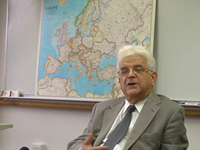
Charles Gati talks to IRP Fellows about the future of Central Europe's relationship with NATO and the European Union. |
Washington- September 19, 2002 - NATO will enlarge greatly at its Prague meeting in November by inviting at least six, perhaps seven, formerly communist countries to join the military alliance, an expert on central and eastern Europe said.
Charles Gati, a professor a Johns Hopkins University's School of Advanced International Studies, predicted in a seminar for Pew fellows that the former Soviet republics of Estonia, Latvia and Lithuania, along with Balkan countries Bulgaria and Romania and the former Yugoslav republic of Slovenia will all receive invitations to the North Atlantic Treaty Organization.
"To the extent there is a done deal in human events two or three months in advance," Gati said, "it's a done deal."
The only question that remains, Gati continued, is whether Slovakia will also be included.
NATO officials have indicated that Slovakia's invitation is dependent on the country's election this weekend. U.S. ambassador to NATO Nicholas Burns warned Slovakia's voters not to count on membership if the former authoritarian leader Vladimir Meciar is elected.
This fall's NATO conference will mark the second time the American-dominated alliance, originally created to counter the Soviet-controlled Warsaw Pact, will expand into formerly communist eastern Europe. In 1999 Poland, the Czech Republic, and Hungary joined NATO's other 16 members.
In addition to NATO, the European Union is planning an expansion eastward this year, although the results are not as easily predictable, Gati said.
"The European Union� I still have my doubts. They're saying 10 new members. That doesn't include Romania and Bulgaria, but would include all the other countries to be invited so they'd be members in 2004," Gati said.
A number of factors could derail EU expansion plans such as Slovakia's elections, an agricultural dispute between Poland and the European Union, and perhaps most interestingly, an Irish referendum.
Last year, the EU foreign ministers signed the Treaty of Nice, which allows for the eastward expansion of the union. All of the 15 member states ratified the plan, except for Ireland. There the treaty was defeated in a referendum in 2001. The Irish government is planning another vote before the end of the year.
"If that fails again�enlargement could come to a halt. That will create extraordinary problems," Gati said. "The hope of joining Europe will disappear."
Copyright © 2005 International Reporting Project. All Rights Reserved.