
|
|
|
|
|
|
|
|
|
|
|
|
|
|

Journalists Learn How to Stay Safe in Hazardous Situations
By Sara Olkon, Fall 2002 IRP Fellow
WOODSTOCK, VA, October 1, 2002 -- As we rode in a rickety white school bus, past a weathered red barn and grass-fed cows in rural Virginia, abduction was the last thing on my mind.
 |
|
|
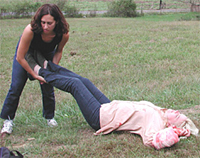
Fall 2002 IRP Fellow Sara Olkon administers first aid treatment to a "casualty" in the training program. |
Suddenly gunshots rang out, our driver slammed the brakes and I heard the rudest of all non-sequiturs: "Get your *** head down!"
I looked up from my outstretched newspaper to see a cabal of angry masked men in camouflage storming the bus. I knew it wasn't real, that it was just part of our two-day safety course, taught by ex-British Royal Marine commandos to help journalists and other civilians deal with dangerous situations, especially abroad. It was relevant for us: Eight U.S. journalists preparing for an overseas reporting stint as part of the IRP Fellowships in International Journalism Program.
Still, my heart filled with dread as one of the armed men jerked my head up with a swift tug of my hair and fit my head with a black cloth hood. Then he yanked me up by my sweatshirt, led me off the bus and placed my hands on the shoulder tops of another hostage in front of me. Then we walked, briskly and blindly, up a hill, over rocks, though underbrush. It was exceptionally quiet, just cricket chirping and the sound of my labored breathing.
Abruptly the line stopped and I was knocked to the ground. I responded with a yelp - shocked more by the idea than the sensation of such an abrupt push down. Next, I was on my belly. Someone grabbed my arms away from my sides and kicked my legs apart. Minutes later, I felt quick hands grope about my pockets, my ears, neck and socks, stopping long enough to unclasp my wristwatch and snatch my ATM card from the back pocket of my jeans. Again, the silence.
As much as I wanted to loosen the hood for more air, I lay still. I was sure I'd earn a swift kick in the head, or worse, if I messed with my mask. The 20-minute ordeal drew to a close as my faux-captors lead me back up a hill. Then, as sudden as it had all begun, I was freed.
The abduction scenario was just one of several acted out over two days by Centurion Risk Assessment Services. The UK-based company, founded in 1995, began as an eight-hour presentation after the BBC asked former Royal Marine Commander Paul Rees to advise its journalists working in conflict zones. Perhaps the most salient lesson from the abduction scenario was the importance of blending in, becoming "the gray man." The captors ignored my little yelp, but my colleague's complaints about her hood earned her a (fake, but realistic-sounding) shot in the head.
Centurion's staff of 14 (six of whom ran our course) is made up of retired British Royal Marine commandos. They offer advice, options and alternatives. With well- publicized attacks on the press, including the murder of four journalists in Afghanistan and the kidnap and slaying of reporter Daniel Pearl in Pakistan, no one in our group seemed blas� about the need for some guidance before heading overseas. The staff said they've already trained at least 8,000 journalists worldwide.
Personally, I found the lessons somewhat comforting, even though I have no plans to cover a war. As part of my IRP Fellowship project, I'm flying to New Delhi later this month to write about public health. Of course, you never know when hazardous situations might arise: I'll be visiting the Subcontinent at a time of heightened Hindu-Muslim tension, with nuclear-armed rivals Pakistan and India battling over the territory of Kashmir.
The lessons were based in classroom theory and practice. Our first exercise took place in a field on a serene farm in Woodstock, Virginia that overlooked a herd of cows. Using small binoculars, we squinted hard searching for signs of danger obscured by nature and shadow. A black rifle blended in with an electric pole, a machete by the bark of a tree trunk.
Back in the classroom, we learned it's better to stay in a second floor hotel room - escape is possible through a window, and what a portable, shrill door alarm can do to an intruder's eardrum. We also discovered that the mundane if often the deadliest: Every 15 seconds someone dies from contaminated food or water, Centurion reps said.
Outdoors again, a handful of us tried to get past a hostile road checkpoint, telling armed guards we were on our way to cover a government-sanctioned celebration, when our real plan was to interview dissidents. With guns pointed at our heads, we tried to bribe our way through with cash, booze and cigarettes.
We practiced making makeshift stretchers from blankets, jackets and tree branches, and holds to carry wounded colleagues to safety. We set off down a country road dreading booby traps and land mines. We learned what to do if a grenade lands at your feet (do not run, instead lay flat as a ribbon, with feet toward the grenade.) We learned about first aid, then practiced on a screaming de-miner who had "blown-off" his hand and had fake blood spurting from his "stump." My casualty was a drunk woman reeling from a domestic dispute, part of beer bottle still sticking in her arm. Another had a land mine victim throw up in her face.
Try as we did for sure-fire strategies, the marines were quick to point out that there are simply no definitive answers when it comes to handling a crisis situation. Best bet? Be the proverbial "gray man": don't draw unnecessary attention to yourself.
Copyright © 2005 International Reporting Project. All Rights Reserved.