

|
|
|
|
|
|
|
|
|
|
|
|
|
|

U.S. Should Do More to Ban Biological Weapons, Expert Says
 |
|
|
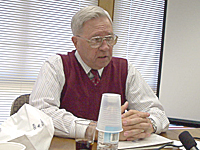
D.A. Henderson talks to IRP Fellows about new, emerging infections. |
WASHINGTON, Feb. 26, 2001 - The U.S. needs to build an international consensus that any work being done with biological weapons is a high crime against humanity, an expert on infectious diseases told IRP Fellows today.
D. A. Henderson, Director of the Johns Hopkins Center for Civilian BioDefense Studies, told IRP Fellows the U.S. "should do a great deal more internationally in terms of detecting cases [of infectious diseases], diagnosing cases, and building a broader consensus throughout the world that any work being done with offensive biological weapons is a real problem."
Henderson said if the use of biological weapons is regarded very negatively throughout the world, and prominent positions are taken politically, the likelihood of use of the weapons would diminish. Henderson cited the discovery in the early 1990s that the Soviet Union was producing offensive biological weapons despite the signing of the Biological Weapons Convention in 1972, as a great concern.
"As the World Health Assembly declared that smallpox was eradicated and recommended that vaccination could stop everywhere, the Soviet Union deliberately undertook a special program to weaponize smallpox," said Henderson, former director of the World Health Organization's global smallpox eradication campaign.
Henderson said the Soviets built a plant outside of Moscow that was capable of producing between 80 and 100 tons of the smallpox virus a year. The virus was intended for use with intercontinental ballistic missiles, he said.
"That plant today is still strictly out of bounds and is one of four plants under the ministry of defense to which no one has access, outside of a very limited number of people within the (former) Soviet Union. What they're doing now, we have no idea," he said.
Henderson said recent published reports from Australia have caused new concern. Australian scientists introduced a special gene, intended to limit the fertility of mice, into a strain of mouse pox, a fatal disease in a certain proportion of mice. The alteration caused mouse pox to kill all of the mice in the experiment, even those vaccinated against the disease, he noted. "The easily-inserted gene increased the virulence of the disease many, many, fold," Henderson said.
The U.S. made a decision in September to produce as many as 40 million doses of smallpox vaccine, feeling that "if smallpox is anywhere on the face of the earth, it's a threat to the United States as well as everybody else," Henderson said. He warned, however, that at this time risks of complications from the vaccine are greater than that of the disease itself, and vaccination is not recommended.
Copyright © 2005 International Reporting Project. All Rights Reserved.