

|
|
|
|
|
|
|
|
|
|
|
|
|
|

Inside the Pentagon's Ground Zero
 |
|
|
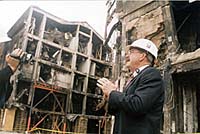
Pentagon reconstruction chief Walker Evey at Pentagon's "Ground Zero." (Photo by IRP Fellow Marc Ramirez) |
|
|
Click here for audio excerpt |
WASHINGTON, October 1, 2001 -- To step into the charred gash of the outer wall of the Pentagon is to enter the "other" Ground Zero of the September 11 terrorist attacks on the United States.
On Monday journalists in the International Reporting Project became one of the first groups of media representatives to be allowed to inspect first-hand the precise point of impact where a terrorist-hijacked American Airlines jet slammed into the Pentagon killing as many as 189 people on the same day that left thousands dead at the World Trade Center in New York.
"When you walk through here," snapped Walker Evey, a Pentagon official in charge of reconstruction, warning us of possible falling debris. "I want you to walk through smartly, no lollygagging, no goofing off, okay? You're going to move!"
Wearing hard hats with U.S. flags, we followed Evey briskly but gingerly into the gap, stepping over a pile of debris on the ground. On the wall, someone - a rescue worker or construction worker? - has scrawled, "Osama bin Laden Must Die."
A smell of smoke still lingers inside many areas of the Pentagon, three weeks after the onset of the searing and persistent blaze set off by the explosion of the plane's nearly full fuel tank. FBI and other investigators are still examining the rubble for clues and to find more remains of victims. So far, 118 sets of remains have been collected.
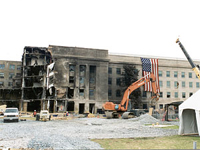
As we crossed into the Pentagon interior, one of our group pointed across the crash site to our left. Immediately adjacent to it are the exposed interiors of five offices. On the third level, one can see photo mementos still neatly hanging in a long, horizontal row. On the fourth floor, a computer monitor rests neatly on a desk, a row of books hardly disturbed on a shelf.
 |
|
|
Terrorist attack left the Pentagon charred, nearly 200 dead. (Photo by IRP Fellow Jonathan Ernst) |
"The guy [on that floor] was standing one foot away from the wall watching CNN when the plane hit," Evey said. "He was knocked across the room, got up without a scratch, opened the door and walked out of the building."
The section of the Pentagon that was hit had undergone extensive renovation shortly before September 11 and not all workers had yet moved back into their offices. As a result, many lives were likely spared. On a normal day, 10,000 people worked in the two "wedges" hit by the jet. On the day of the attack, 4,600 people were in the area, according to Evey.
On the outside, much of the damaged section of the Pentagon remains charred from the smoke and fire. Inside, workers are painstakingly clearing debris and dealing with problems such as mold left by the huge amounts of water released by a new sprinkler system that had just been installed during the pre-September 11 renovations.
Our group emerged from the damaged area and into a somewhat surreal contrast: more than 20,000 daily workers going about their business in the Pentagon, still one of the largest office buildings in the world. The cafeteria offers a Mexican lunch special, drug stores and banks are open and a ceremony honoring the Pentagon's "civilian employee of the month" goes on as before.
"This is a very tough building, a very resilient building," Rear Admiral Craig R. Quigley, the deputy assistant secretary of defense for public affairs, said. Planners had fortified the building against terrorist attacks such as a truck bomb. No one expected an attack from a fully loaded commercial airliner.
Reconstruction is expected to last years, Meanwhile, for Pentagon workers, there are many reminders of the attack. Scores of banners with expressions of condolences sent by schoolchildren and other Americans adorn the miles of corridors. Amid tight security, senior officials are working long hours, coordinating the American response to September 11 and preparing for what Quigley called a "global effort of years' duration."
"America has never fought a war like the one we are about to fight," said Quigley. He added, "there will be a military component" to go along with the groundwork being done on diplomatic, financial and legal fronts.
Another Pentagon official, who requested his name not be used, recalled standing on the opposite side of the Pentagon on September 11 when the plane hit the building. "I was watching the television coverage of the World Trade Center attacks and I thought it was 'surround sound' from the television," he recalled. Asked how he felt continuing to work in a building that had been the object of an attack, he expressed anger at the failure of security officials at the U.S. airports from which the hijacked flights originated.
"This was the most predicted surprise in history," the official said, noting that experts have for years been predicting a terrorist attack in the United States. "Ten cents worth of greater security could have prevented those planes from being hijacked."
Quigley said he and other officials are meeting with representatives of U.S. news organizations to seek improvements in media access to any future military action. In past conflicts, from the Vietnam War to the Gulf War and actions in Grenada, Haiti and Kosovo, journalists and the military have often been at odds over how much freedom the media should have in covering wars. Limited coverage by "pools" of journalists has satisfied neither side.
"The pool arrangement is the preference of neither the military nor the news organizations," the spokesman said.
Copyright © 2005 International Reporting Project. All Rights Reserved.