

|
|
|
|
|
|
|
|
|
|
|
|
|
|

Africa Expert Decries "Global Apartheid"
 |
|
|
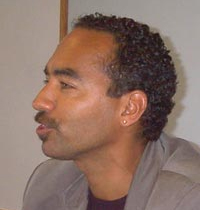
Salih Booker speaks to Fall 2000 Fellows about global apartheid |
|
|
Click here for audio excerpt |
Washington, September 21, 2000 - A system of "global apartheid" in which citizens of rich countries have more resources and access to human rights than those in poor countries is greatly harming Africa and parts of South Asia, an expert on Africa told IRP Fellows today.
Salih Booker, director of both the Africa Fund and the Africa Policy Information Center (APIC), said globalization has created a global apartheid with "gross disparities" that are increasing despite "enormous economic growth." Booker said the term apartheid, describing the former system of racial separation in South Africa, was a useful metaphor for emerging global trends that enrich parts of the world over others.
"Global apartheid is perpetuated by racism that is imbedded in economic processes, political institutions, and cultural assumptions," said Booker, a former director of African studies for the Council on Foreign Relations. Global apartheid includes not only economic inequality but also "global inequality in access to basic human rights." Booker said disparities are often "invisible to elites by implicit double standards that assume inferior rights are appropriate for certain others, defined by location, or origin, or race."
Booker said the AIDS crisis in Africa is an example of global apartheid.
"The AIDS pandemic and its consequences, and its severe declines in the life expectancies in Africa, provides a dramatic and needed reminder that it's not only global inequality that's increasing, but the distribution of suffering� clearly linked to place and race," Booker said. He cited a World Health Organization report that 44 of the 52 countries with life expectancies less than 50 years are in Africa.
Booker said an historical double standard in American foreign policy towards Africa began with slavery and its definition of people as subhuman. He cited "gross disparities" between US responses to humanitarian crises in Europe, such as Kosovo, and emergencies in Africa, such as conflicts in Sierra Leone and Rwanda.
Africa will likely continue to be "marginalized" in U.S. foreign policy, he predicted, based on press reports indicating "both Gore and Bush have made it plain they don't intend to change the basic American proposition that we have no strategic interest in Africa that would require any significant economic investment or military intervention."
Copyright © 2005 International Reporting Project. All Rights Reserved.