

|
|
|
|
Covering Homeland Security - a McCormick Tribune Specialized Reporting Institute |
|
|
|
|
|
|
|
|
|
|

Russia Makes Progress on Economic Recovery But Takes "Step Backwards" on Democracy, Scholar Says
 |
|
|
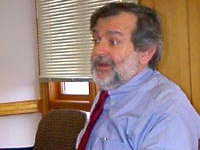
Ilya Prizel speaks to Fall 2000 Fellows about political change in Russia |
|
|
Click here for audio excerpt |
WASHINGTON, Sept. 13, 2000 -- Russia has made an impressive comeback since its 1998 economic crisis, but is "taking a step backwards as a democracy" as a result of recent moves under President Vladimir Putin, a top scholar on Russia told the IRP Fellows in International Journalism here today.
Ilya Prizel, senior research professor of Russian Area Studies at the Johns Hopkins University's School of Advanced International Studies (SAIS), said that Russia's "recovery from the economic crisis has been far better than any of us expected." The country's has an economic growth of between five and 10 percent a year, with small-business growth particularly strong, he said. The government has done a good job of reducing organized crime's threats against entrepreneurs, Prizel added.
However, in a seminar tracing Russia's historical cycles of "disintegration" followed by periods of "reconsolidation," Prizel told the journalists that "Russia is re-emerging as a pseudo-authoritarian national state," one that is increasingly using nationalism as a "legitimating ideology."
Prizel said recent moves against the freedom of Russia's broadcast media and Mr. Putin's announcement of a "new doctrine on information" spell potential trouble for freedom of expression. Efforts to increase power at the top of the government means that "Russia will not be a democracy for at least another generation," Prizel said.
In the long term, though, there is reason for optimism about Russian democracy because of the "emergence of an autonomous middle class" interested in maintaining economic and cultural links with the rest of the world, Prizel said. A hopeful sign is the growth of a civil society with grass-roots and local organizations performing functions traditionally left to the central Russian government.
Prizel said it was likely that Russia would eventually emerge as a country similar to Spain or Italy, with a "dynamic, small-scale economy" and a genuine democracy with growth directed "from below, not from the top down." In the meantime, Russia's road towards democracy will be "prolonged, painful, with many undemocratic episodes," he said.
Copyright © 2005 International Reporting Project. All Rights Reserved.