

|
|
|
|
|
|
|
|
|
|
|
|
|
|

Threats to Journalists Worldwide Unabated
 |
|
|
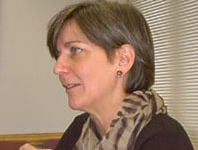
Ann Cooper speaks to IRP Fellows |
|
|
Click here for audio excerpt |
WASHINGTON, Oct. 12, 2000 - Thirteen journalists have been killed worldwide so far in 2000 in the course of doing their jobs, Ann K. Cooper, director of the Committee to Protect Journalists (CPJ), said today. Last year 34 journalists were slain, according to the New York-based watchdog group.
In a talk to IRP Fellows in International Journalism, Cooper said the growth of the Internet had "good and bad" consequences for journalists working in countries with repressive regimes. In Cuba, for example, "thirty to forty independent journalists" have been able to use the Internet as a way of escaping Cuban censors to send news reports overseas. However, several of them have been jailed or placed under temporary "house arrest" as a consequence of their reporting, she said.
In China, with a large potential audience for Internet reporting, the government has recently announced harsh new measures designed to have a "chilling effect" on journalists and others who send information through the Internet. "They're pushing harder than anyone I can think of to control the flow of information," Cooper said of the Chinese government.
Cooper said that not every restrictive government has cracked down on Internet reporting. In Malaysia, for example, the government has left alone an online newspaper that reports independently because authorities "want to encourage the use of new technology" to attract investment, she said. However, with traditional media such as print and broadcast, the Malaysian government still uses the threat of rescinding licenses as a way to force journalists to practice "self-censorship."
Each year, the New York-based CPJ issues a report on threats to press freedom and chooses the ten worst "enemies of the press" worldwide. This year's worst ten were leaders in Sierra Leone, Iran, Yugoslavia, China, Tunisia, Kazakhstan, Cuba, Angola, Peru and Malaysia.
In Yugoslavia, former president Slobodan Milosevic used restrictive laws and financial pressures to intimidate journalists in his crackdown on independent Serb media, Cooper said. "We hope it will be different" now that Milosevic is no longer in power, she said.
Cooper said she recently went on a CPJ mission to Angola to meet with government and media officials in that African country, where a strict new press law against "dishonoring the president" would subject journalists to punishment. "Even if what you're writing is the truth, it's no defense," under the Angolan law, Cooper said.
Copyright © 2005 International Reporting Project. All Rights Reserved.