The Kenya Hillary Clinton Should See
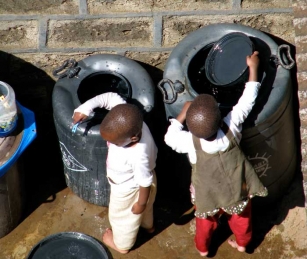
Children in Kibera slum in Nairobi, Kenya. Kibera, which houses almost 1 million people, is the largest slum in Africa and one of the biggest in the world.
One-third of the Kenyans in this capital of east Africa live in the hivelike alleys of Kibera, an unofficial settlement of mud huts and raw sewage. A million Nairobi citizens reside here, in Africa's largest slum, with little water and no sanitation. And they've lived like this, officially overlooked, for some 40 years.
A visitor steps gingerly through the maze of alleys until a question arises: Why is the ground sliding around? Used plastic bags are poking out from the mud, and you realize what's underfoot: what until recently were the contents of Kibera's stomachs. These are the country's infamous "flying toilets" deposited in layers to form the foundation of Nairobi's biggest neighborhood. To tour Kibera is to walk on land made literally of human waste.
There's a great deal of lip service given to Kenya's multiparty government — a compromise brokered by former U.N. Secretary-General Kofi Annan in the wake of explosive violence that followed a botched, and most believe stolen, presidential election in December 2007. But this government isn't getting much done for the citizens of Kibera, who seem resigned to being treated like human waste by their leaders.
One group of AIDS orphans welcomes visitors with songs about shoes — how all God's children have them; and so do these toddlers, even if some are wearing deceased parents' outsized flip-flops. A caring adult has plaited and braided hair today, stringing colorful beads on the little girl with crossed eyes and making sure another has a bow. It's left to the NGOs and the Kiberans themselves to tend to these neglected kids, who will spend their days in makeshift mud-walled classrooms that bake like tandoori ovens in the heat.
When the long rains come, these mud stalls will melt and rush down the gutter, and these children will be left out in the heat, to steam like the sidewalks until another refuge can be found.
There's no shortage of refuge for Kenya's political class. The private residence of Prime Minister Raila Odinga is getting a makeover this year — $4 million in public funds to better equip his home for entertaining guests.
As for avoiding the sewage, government ministers enjoy some 11,000 publicly financed cars — Mercedes, Range Rovers and the like, according to Kenya's National Commission on Human Rights. In just his first 18 months in office, President Mwai Kibaki managed to buy another $12 million in luxury vehicles, a sum estimated by the human rights commission and the Kenya chapter of Transparency International as enough to pay for eight years of school for 25,000 children, or HIV/AIDS treatment for 147,000 people for a whole year.
These may be some of the reasons no one in Kibera expects much from the country's leaders. So life marches on in Kibera, where Africa's enterprise is on full display. You can slaughter your chicken or buy your coal or your cell phone minutes, or get a funeral or a bath or a wheelbarrow to bring your vegetables to a market; or pump up your soccer ball, or copy your pal's reggae CD. Or you can buy a pair of rubber shoes — the better to navigate the muddy, slimy, soggy pathways that you live on.
Once you get used to the filth, it's easy to walk over Kibera's sidewalks and ignore what you're walking on — and apparently, everyone does. Maybe it takes an outsider to look down and realize who and what is really being walked on.
Kitty Eisele is supervising editor at Morning Edition. She recently traveled to Kenya with the International Reporting Project, affiliated with the Johns Hopkins School of Advanced International Studies.
More from this Reporter
- There are currently no related stories for this author.
From Other Reporters in This Country
Also appeared in…
- NPR
