Pussy Riot’s Conviction and Free Speech in Russia
Back in February, art provocateurs Pussy Riot stormed the stage of Moscow’s Cathedral of Christ the Savior in their signature balaclavas. For less than one minute—before being escorted away—they lip-synced a “punk prayer” that chastises the Church as a government lackey and pleads for the Virgin Mary to “Drive away! Drive away Putin!”
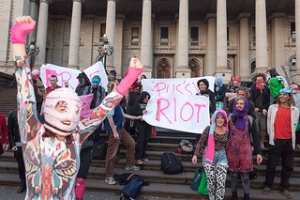
A show of solidarity in Melbourne, Australia
Photo: Mark Burban
After more than five months in detention, three of Pussy Riot’s members were found guilty of “hooliganism motivated by religious hatred” and sentenced to two years in prison. That the performance was interpreted as a religious rather than political protest leads Simon Shuster of TIME to explore the growing affinity between the President Putin and the Orthodox Church.
Amnesty International considers Pussy Riot “prisoners of conscience” and has declared their conviction “a bitter blow for freedom of expression.” Human Rights Watch described it as “inappropriate and disproportionate” while calling for their immediate release. Protests defending the group have occurred across the world with many artists, musicians and celebrities voicing their support.
On PRI’s “The World,” Pyotr Verzilov, husband of jailed Pussy Riot member Nadezhda Tolokonnikova, remarked to IRP Gatekeeper Lisa Mullins (Korea 2007) that the trial “smelled like the Middle Ages.” Also for “The World,” Gatekeeper Editor Carol Hills (Nigeria 2007) produced a cartoon slideshow of the women, who observed their trial from a glass cage in the courtroom.
Pussy Riot’s case raises important questions about civil rights in Putin’s Russia.
In The Washington Post, IRP Gatekeepers Kathy Lally (Lebanon and Syria 2004) and Will Englund (Korea 2007) describe an ongoing crackdown against members of the opposition after highly contested parliamentary elections in December and a contentious presidential election in March. Despite numerous raids and a bevy of summer laws that impose punitive restrictions and penalties for protests that are unsanctioned or violate the public order, they observe that Russians continue to publicly assemble.
Others have suggested that Western narratives that depict Pussy Riot as dissidents feeling the wrath of an authoritarian regime are overly simplistic. Vadim Nitkin argues in the New York Times that Pussy Riot’s more radical underpinnings have been obscured by superficial interpretations. At The Atlantic, Sarah Kendzior extends this line of thought to how the Western media overlooks a message of revolution.
The case reveals a Russia divided.
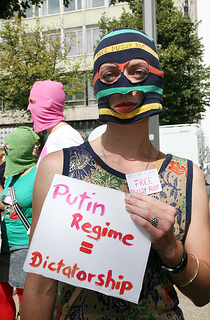
Photo: linksfraktion
“Although the Russian Orthodox Church has supported the rockers’ prosecution, the charges have angered many here, believers and non-believers alike, who say the women may be guilty of disorderly conduct but should not be in jail,” Kathy Lally reported for the Post last month.
Yet GQ Russia editor Michael Idov has pointed out that many Russians “remain distinctly uncomfortable with activist women.” At Al Jazeera English, Anatoly Karlin highlights some of the more tendentious exploits of Voina, Pussy Riot’s political art precursor, which may have previously alienated some of the Russian public.
Lally has also reported on the lonely pursuit of protests in rural areas of the country. “People have plenty to protest here — the steady decline of manufacturing and loss of jobs, low pay, lack of political freedom — but most grumble quietly at home,” she wrote on July 11.
The implications of this trial extend further than a single case of restricted speech. Fred Weir at The Christian Science Monitor interprets the conviction as establishing a precedent for future protests. The death of Sergei Magnitsky in 2009 and charges recently reintroduced against Alexei Navalny are only two examples that reinforce an authoritarian image of Putin’s Russia, according to an unsigned editorial in The Washington Post that urged Congress to pass the Magnitsky Act and impose sanctions on violators of human rights in the country.
Still, Bloomberg’s Stephan Kravchenko and Henry Meyer postulate that the trial will further embolden the protesters and help build momentum for the opposition movement. Putin’s popularity has recently waned to an all-time low of 48% as rated by the independent Levada-Center. A national online vote scheduled for October 7 will see the opposition attempt to identify leaders and unite a fractured movement before protests scheduled for the coming months, says Gleb Bryanski of Reuters.
Join the discussion on Twitter! You can reach us at @IRPChirps.
Ethan Katz is a communications assistant at the International Reporting Project (IRP).
Your donation helps continue the IRP's work to inform the public about international issues.
Make A Gift