How Is Brazil Preparing for the World Cup and Olympics?
No small amount of pressure accompanies the prestige of hosting an international sporting event such as the World Cup or Olympics. When Brazil was awarded both the 2014 World Cup and the 2016 Summer Olympics, the pressure escalated quickly. How will the country balance an economic slowdown, massive infrastructure projects, and controversial slum removal campaigns in anticipation of the two events?

Venue for the 2016 Olympic Games
Photo: Jorge Andrade
Back in 2009, IRP Gatekeeper Greg Victor (Brazil 2001) reflected on Brazil’s rapid ascent to the developed world. As a BRICS nation in the midst of rapid economic development, Brazil has succeeded in maintaining this growth while simultaneously reducing poverty and inequality. According to Brian Winter, an IRP Gatekeeper to Turkey in 2008 and Reuters’ Chief Correspondent in São Paulo, 15 percent of Brazil’s population—a total of 30 million people—entered the middle class during the past decade.
While Brazil has not faced the spikes in unemployment and austerity measures of the United States or Europe, its once booming economy has been slowed by the global recession. After expanding 7.5 percent in 2010, Brazil’s economic growth dropped to 2.7 percent in 2011, and Winter suggests that “infrastructure bottlenecks” could halt growth even further. Indeed, recent estimates place the figure for 2012 between 1 and 2 percent.
Theresa Bradley was in Brazil on an IRP Fellowship when the country was awarded the XXXI Olympic Games, and she reflected on Rio de Janeiro’s 2007 Pan-American Games. “Organizers risk repeating the mistakes of the 2007 Pan-Am Games,” she wrote at the time, “which saw promised roads, subways and clean-up go undelivered and prompted investigations into budget irregularities.” Brian Winter reported last month that the Pan-Am Games went as much as six times over budget.
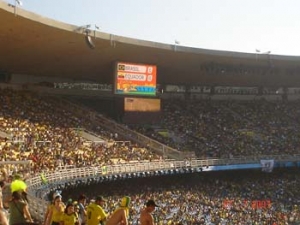
The Joao Havelange Olympic Stadium also hosted the 2007 Pan-Am Games.
Photo: Jorge Andrade
Moreover, not everyone believes a sporting event of this magnitude will generate long-term economic growth. Stephen J. Dubner of The New York Times Freakonomics Blog questions the wisdom of hosting an event like the World Cup. Similarly, Charles Riley of CNNMoney compares hosting the Olympics to “throwing the world’s largest—and most expensive—party… And most of it happens on the taxpayer dime.”
Brazil is planning major infrastructure upgrades, both to prepare for the rapidly approaching international spotlight and to address economic malaise. This time around, as Winter reports, $66 billion will be invested in infrastructure, with a heavy emphasis on the private sector. With this move, President Dilma Rousseff has embraced the business community—much to the chagrin of her traditional Workers’ Party base.
These anticipated investments should benefit the majority of citizens, but it will not reach all Brazilians. As Simon Romero details at The New York Times, 170,000 of Brazil’s poorest may be evicted from their homes in the name of space and security. Theresa Williamson, founder of Catalytic Communities, argues that instead of forcing favelas into the periphery, Brazil has missed an opportunity to make long-term investments in their integration.
Even so, polls show that the government enjoys a 57 percent rate of approval with Rousseff herself sitting at a lofty 76 percent, Winter writes. A successful 2014 World Cup and 2016 Summer Olympics will no doubt only see these numbers rise.
Join the discussion with us on Twitter!
Ethan Katz is a communications assistant at the International Reporting Project (IRP).
Your donation helps continue the IRP's work to inform the public about international issues.
Make A Gift