Jina Moore's Blogs
-
The Real Issue With Africa and the ICC
After all the reporting trips you've read about here, all the stories I've done about war and justice and voice and violence, I'm massively persuaded that Rebecca Hamilton is right in her analysis, at Foreign Policy, of the arguments against the ICC blistering around Africa right now: The court's all-African line-up is not an ICC problem; it is an African problem, for which there is an African solution. That solution -- doing the hard work of strengthening of domestic accountability mechanisms in nations across the continent -- is what African leaders should be discussing this weekend. Unfortunately, they will instead rail against, and possibly abandon, the only recourse for justice that African victims of major international crimes currently have. One reason I'm so persuaded? Because Fatou Bensouda, chief prosecutor of the ICC and a Gambian national, calls...
-
How Much Does Africa Spend on Health?
That's what the ONE campaign wants to know. They've kicked off a petition to ask African leaders to publish their health budgets -- promises and actual spending -- for better accountability on outcomes. It's also about accountability for past promises. In 2011, African countries signed a declaration in Abuja to commit 15 percent of their national budgets to health. Ten years later, only 26 had fulfilled the pledge. But it's hard to know how much progress is being made if governments don't regularly publish their budgets. That's obvious. Less obvious is that it can also be hard to keep an eye on the difference between a proposed budget and an actual budget. In some cases, there can be a real shortfall: What South Sudan budgeted to spend in 2012, and what it actually could spend,...
-
Sick in Africa? Get Thee to a Cargo Container
The next Chinese incursion into Africa is coming by ship. Last year, in a pilot program, China trained 10 doctors in how to use a "container hospital," which seems to be exactly what it sounds. It's a cargo container cum portable hospital, and if there's power and water -- and, of course, supplies -- it can do virtually anything a clinic can do. Cargo containers have several second lives on the continent already, of course. I've seen them converted into sleeping quarters, small shops or hair salons. But the Chinese have done a systematic hospital-in-a-box; depending on the space available, the cargo hospital can include, say, an intensive care unit or a pharmacy. You can also fill them with all kinds of equipment, of course. Ideally, though, they're deployed as 1...
-
The News on AIDS in South Africa is Not What You Think
The "AIDS in Africa" story we know in the West is bleak: HIV is spreading across the continent, accosting and killing men and women by the millions. That's a static story, an image that got shaped more than a decade ago and hasn't changed much since. The numbers alone suggest an overwhelmingly different narrative. I've written about <a data-cke-saved-href="http://www.csmonitor.com/World/Africa/2013/0623/AIDS-How-South-Africa-is-beating-the-epidemic?nav=87-frontpage-entryLeadStory" href="http://www.csmonitor.com/World/Africa/2013/0623/AIDS-How-South-Africa-is-beating-the-epidemic?nav=87-frontpage-entryLeadStory" _blank"="">progress on AIDS in South Africa in this week's Christian Science Monitor cover story. I also spend a lot of time with caregivers who stepped up to help the children of the disease's early victims, and whose sacrifices continue even as things get better for the sick. Jina Moore is a 2013 IRP New Media Fellow reporting from South...
-
Why This Rocks: J. Lester Feder on Same-Sex Marriage in South Africa
First and foremost, it's about South Africa. There's no universalizing paragraph linking the issue in South Africa to the rest of the continent; where there is that link, it's subtle and sensical, connecting the South African story to other stories because they are actually connected, not because the piece, to exist, has to say something about "Africa." That means what's missing is as fulfilling as what's there: There's no recitation of the now-familiar legal assault on gay rights in Uganda, or the turnaround in Malawi, or the general prejudice in so many places about which it would be so easy to generalize -- and with which it would be so easy for the story to prop up its own importance. Instead, it's about this irony: South Africa legalized same-sex marriage in 2006. It grants asylum to people on...
-
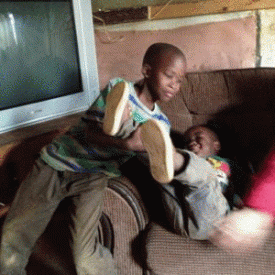
Sunday in Olga’s Shack
At least, it's what my Sunday looked like, when I visited Olga and her family in Tshepisong, not far from Johannesburg. If you look closely, you'll see this is a tin shack. But you have to look closely, because nine-year-old Bokamoso and his three-year-old brother, Neo, are having so much fun with each other, they'll distract you. PS: That blurry white hand in there belongs to an amazingly good-hearted woman who drove us to visit Olga, who is a friend of hers, and whom Neo cackles at every time she tries to tickle him. Jina Moore is a 2013 IRP Fellow reporting on global health from Rwanda. This post originally appeared on her blog.
-

Boss Me Around in Africa!
I’ve just landed back in Rwanda, which loyal readers who’ve forgiven years of mostly silence on this blog will recall as my favorite place on Earth, and I’m gearing up for some really exciting work with the International Reporting Project, as one of their six New Media Fellows this year. By the way, this crop of New Media Fellows, IRP’s first, is something special (if I’m allowed to say so). After stiff competition for only six spots, guess what happened? We’re all women. We’re diverse – I’m the only white face in the crowd – and we’re all over the world. Also, we’re engaging with media not just as traditional journalists, but as bloggers, novelists, poets, publishers and more. So if you aren...
-
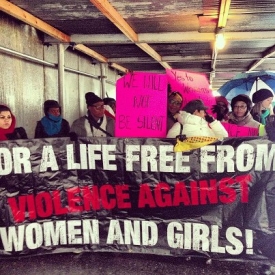
Happy International Women’s Day!
I wish I was in Bukavu today, where I've met so many strong, amazing women fighting against not only the horrors (rape) we often hear about but against gender-based discrimination and violence, and fighting for a new way of imagining women in the world -- with their own voices, strongly and clearly sharing their own ideas, not only about their own lives, but about the future of their country. You wouldn't think it to read the news, but Bukavu can be an inspiring place. I wish I was in Kigali today, where more women make laws in Parliament than men. It was the first country in the world to achieve this distinction, and it's something deeply meaningful to other women I've met there. They may not be traditionally powerful, but they feel empowered, and you can see and hear...
-
Why Do We Still Get Violence Against Women So Wrong?
This week, the American Congress finally resolved its squabbles and brought itself to reauthorize the Violence Against Women Act. It was a fight, as many others will tell you. But there's another battle still to fight, and that's how we talk about violence against women. On Thursday, TIME magazine published a photo essay by Sara Naomi Lewkowicz. The essay began as a project about a woman named Maggie and her boyfriend, Shane. One night, an argument escalated to physical assault as the photographer was taking pictures. The internet went crazy, blaming Sara for not trying to stop the violence -- even though she called 911. Even though her presence probably kept Maggie safer than she might otherwise be, based on what Shane was screaming as he beat her. Even though the police are using Sara's images to prosecute...
-
ARVs Made Easy in Uganda?
Here's something that piqued my interest: Yesterday, Ugandan drug manufacturer Quality Chemicals announced that it's going to manufacture a single pill to replace the cocktail of anti-retroviral (ARV) drugs used to prevent the progression of HIV. A central problem in treating HIV is making sure patients take the right drugs at the right time. Public health professionals call this "compliance," and it's not easy. The drugs also require proper nutrition to work, and patient follow-up care. A comprehensive review of long-term retention of patients on ARV treatments found programs in sub-Saharan Africa lose 40 percent of their patients by the end of the second year of treatment, mostly due to follow-up care obstacles. Anything that makes it easier to treat people is surely a good thing. It's tempting to think that local manufacturing of drugs is also a good thing,...
Your donation helps continue the IRP's work to inform the public about international issues.
Make A Gift