Photo Essay I: Evolution of terror
|
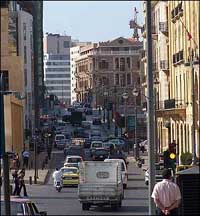
Downtown Beirut has undergone reconstruction since 1990, when the devastating 15-year civil war between Christians and Muslims ended. Photos in this four-part series llustrate the day-to-day lives of Lebanon's citizens in the aftermath of that conflict. |
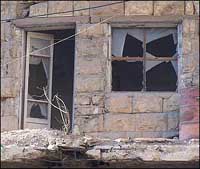
| Some buildings, especially those on the former Green Line � the boundary dividing the Muslim and Christian sections of Beirut � still bear the signs of war. |
|
|
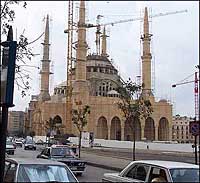
A mosque under construction in downtown Beirut is one of the many ventures slowly transforming the city. |
|
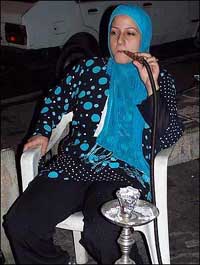
A young woman smokes tobacco out of a long pipe on the Mediterranean seaside on the first day of Eid al-Fitr, the holiday that ends the Muslim holy month of Ramadan. Beirut, with its mix of modern and traditional styles, is a stark contrast to some other Middle Eastern cities. |
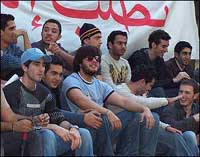
| Students at the American University of Beirut, often a hotbed of political activity, protest the country's requirement of military service. |
|
|
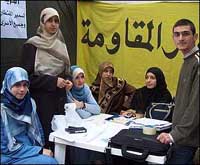
American University of Beirut students campaign for student elections. |
|
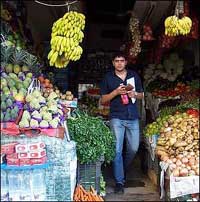
A man walks out of a fruit and vegetable stand in west Beirut. |
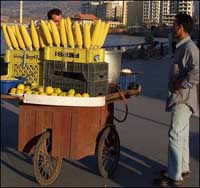
| Vendors sell corn on the cob along the Mediterranean Sea in Beirut. |
|
|
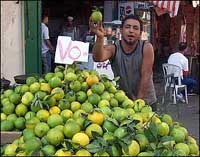
A man shows off his fruit stand in the marketplace in Sidon, a seaport city in southwestern Lebanon that is predominately Sunni. |
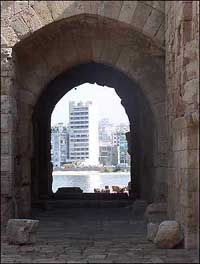
| The Sea Castle built by the Crusaders in the early 13th century is one of the main attractions in Sidon. |
|
Copyright © 2005 International Reporting Project. All Rights Reserved.