Blogs’ Influence on International News Increases
WASHINGTON, February 15, 2006 — CNN's former Northeast Asia bureau chief has a lot to talk about these days, and she's doing it mostly online as a high-profile blogger.
|
|
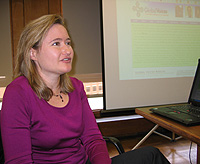
| Rebecca MacKinnon |
"If you care about an issue and you feel it's not getting enough attention," said Rebecca MacKinnon, a blogger and research fellow at Harvard Law School's Berkman Center for Internet and Society. "If your blog is read by enough people, if you start yelling and screaming about something that you think is important, you can get that into the media."
At a seminar for the spring 2006 International Reporting Project Fellows, MacKinnon described to IRP Fellows what she did when she learned that Microsoft MSN deleted the website of outspoken Chinese blogger and journalist Zhao Jing, aka "Michael Anti," at the request of the Chinese government.
Anti had supported a walkout by journalists at the Beijing Daily News to protest the firing last year of several Chinese editors who had spearheaded daring investigative coverage. In response, the Chinese government requested that Microsoft MSN Spaces delete Anti's blog. MacKinnon, concerned with freedom of speech online, wrote about the incident in her blog, Rconversation. "What American companies are doing in China to comply with censorship is creating a business model for censorship that can be applied anywhere," said MacKinnon. Her item was picked up by a record number of other blogs, and eventually became one of the most frequently cited blog entries in the entire blogosphere. Eventually, The New York Times, Newsweek and other news outlets picked up the story.
MacKinnon says Internet companies like Yahoo or Google need to think through their policies for responding to censorship requests by governments. "Nobody needs to pull out of China, but companies can think about what they do and don't do for their business long term, including [considering issues such as] user trust."
She spoke of the immense potential of blogs –- what she calls “participatory” or “citizen’s” media –- to enhance and enrich journalism. She and another Berkman Center Fellow have founded an online citizen's media network called Global Voices Online. "It's a team of bloggers around the world," said MacKinnon. "We are aggregating, curating, and amplifying these conversations. Here's what this guy in Iran is doing. Our Palestinian blogger gives us a feature on the conversations taking place online in cyber-Palestine. We have Costa Rica, etc. We're learning a tremendous amount about the culture of blogging, and how it's emerging, but also learning about the nature of citizen media and how it relates to professional journalism."
She advised the IRP Fellows and SAIS students to treat blogs as they would any source they used for a story. As with every source, bloggers have an agenda and a particular point of view. She advised them to verify the information they read in blogs, and to “question the way the issue has been framed.”
Copyright © 2005 International Reporting Project. All Rights Reserved.